
Ask any production manager at a manufacturing company what one of the most frustrating problems is when managing projects, and the answer will almost always be the same: the actual costs only show up too late. It is only when the project has already been completed — or worse, when the client has already received the invoice — that it becomes clear a particular phase has taken twice as many hours as planned.
The problem isn’t a lack of data. It’s that cost data and project data are stored in different places: the accounting system on one side, the time schedule on the other, and timesheets somewhere else. Gathering them and bringing them together takes time, and by the time you have the full picture, it’s already too late to take action.
CONTENT
- Direct costs, indirect costs, hours worked: can you see them all at a glance?
- How Twproject integrates costs and progress into a single system
- How Twproject provides practical support for budget-based projects
- Innovation, research and external reporting: the Oberalp case study
- Do you want to know the true cost of projects, in real time?
Hai capito di chi stiamo parlando?In this article, we want to offer you a practical solution for consolidating all your project cost management within a single system – the only one truly capable of managing the complexity of project costs and transforming it into a clear, manageable overview at multiple levels. Do you know who we’re talking about?
Direct costs, indirect costs, hours worked: can you see them all at a glance?
For a complex business such as those in the production sector often are, a comprehensive project budget does not consist solely of purchased materials and services. It includes the hours worked by the development team, those spent on production, ancillary expenses and the costs of external stages. Keeping track of all this on separate spreadsheets — and then reconciling them at the end of the month — is a slow, error-prone process that is inherently behind the actual progress of the project.
The right question is not ‘how much have we spent?’ but ‘how much are we spending now, compared with what we had budgeted for this phase?’. Only with project reporting based on real-time data is it possible to take action whilst the project is still ongoing.
Traditional accounting software for production companies – or, worse still, homemade systems – are not suited to the comprehensive management of all processes relating to project costs.
To avoid the tedious process of transferring data from one system to another and the resulting incomplete data, you can rely on professional software such as Twproject, which is designed specifically for manufacturing companies and has an in-depth understanding of all their challenges, critical issues and potential for development.
How Twproject integrates costs and progress into a single system
Going into more detail: in Twproject, cost management is not a separate module that you consult at the end of the month; it is integrated directly into the project, phase by phase.
A budget can be allocated to each phase, which is continuously compared with the estimated costs and the costs actually incurred — updated as staff record the hours worked on each activity.
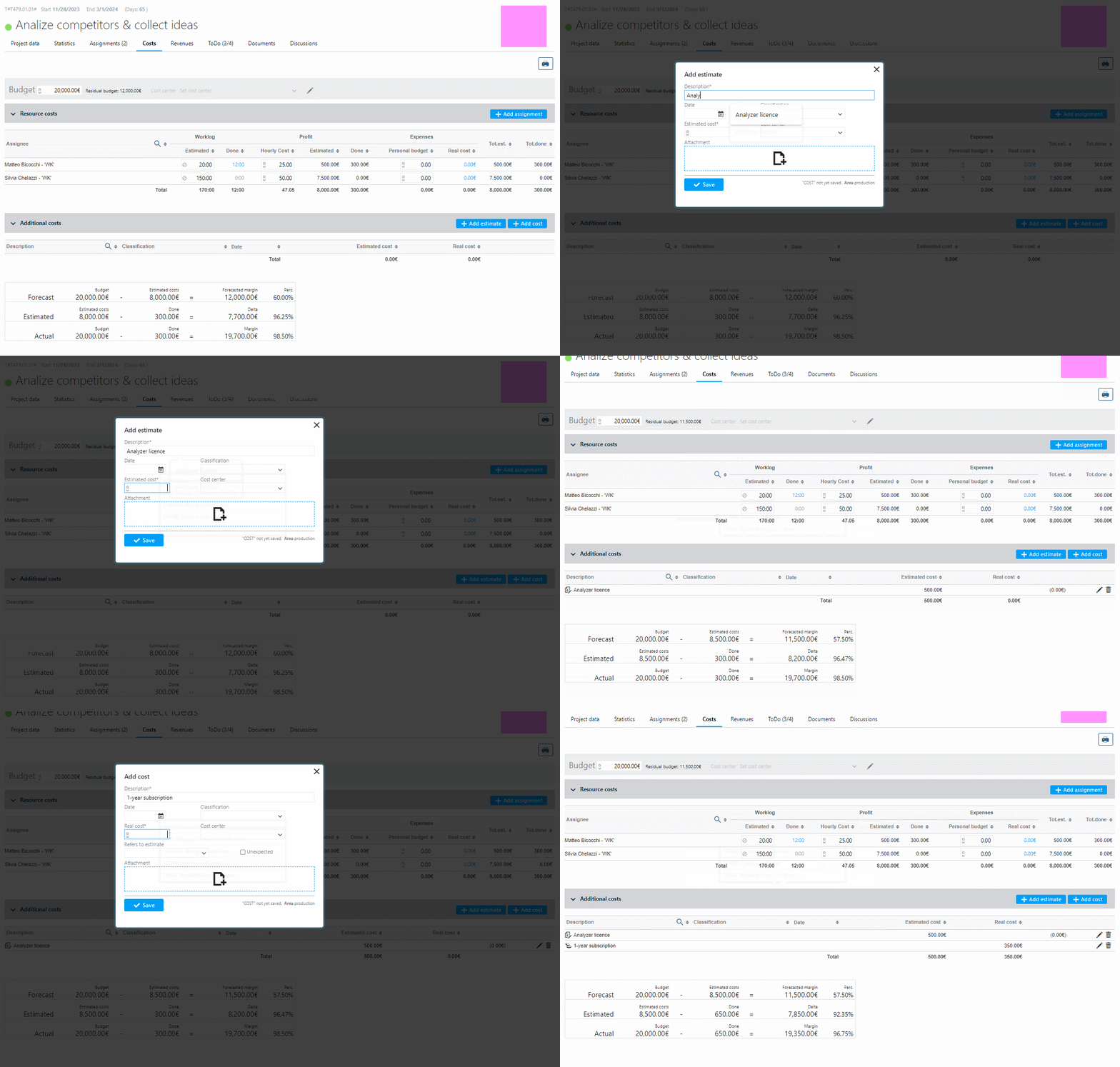
The system automatically calculates staffing costs based on the configured hourly rates, and allocates them to the direct costs recorded for each pahse.

A comparison between the budget, the estimate and the final figures is always visible, without the need for manual data extraction or processing. When a phase exceeds its allocated budget, Twproject sends an alert: not a generic notification, but a specific alert indicating which phase is affected, the extent of the variance and the impact on the overall progress of the project.
This is closely linked to the project structure [: a well-defined WBS is essential for truly accurate financial control. If the stages are unclear, costs cannot be allocated accurately.
How Twproject provides practical support for budget-constrained projects
The centralised management offered by Twproject translates, in the day-to-day operations of a production company, into precise tools that step in exactly where cost control tends to get out of hand. The software is, in fact, designed to make an inherently complex task such as cost control manageable, and it does so by solving very practical problems:
- Hours recorded manually, costs identified too late → Twproject offers integrated time tracking that automatically links hours worked to hourly rates, in real time.

- Expenses and suppliers scattered across different files → Twproject centralises the recording of expenses, materials and suppliers directly within the project, in one place.
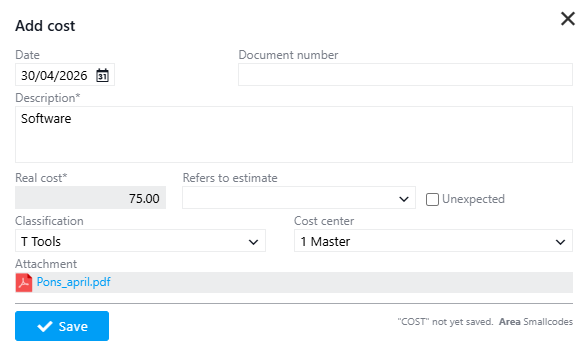
- Variances only identified at the end of the project → Twproject displays a cost dashboard updated in real time, with variances highlighted as soon as they arise.

- Planned and actual figures need to be cross-checked manually, risking errors → Twproject brings baselines, planned and actual costs together in a single view, eliminating the need for manual comparisons.
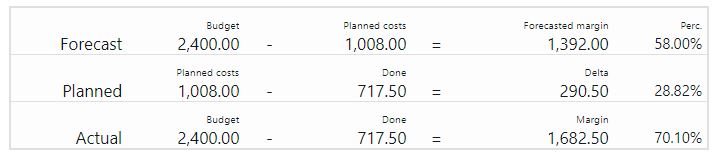
- Project performance assessed intuitively → Twproject calculates financial forecasts based on the project’s actual trend, anticipating problems before they become critical.
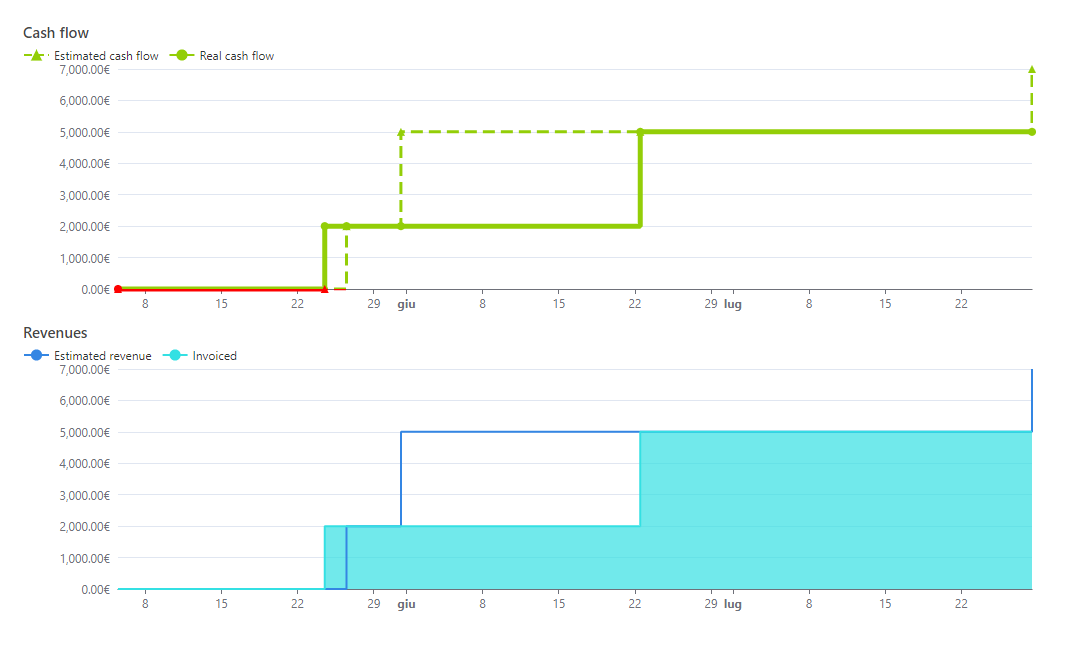
- Customised financial reports for each client → Twproject generates comprehensive financial reports that can be exported and are ready to be shared with stakeholders.
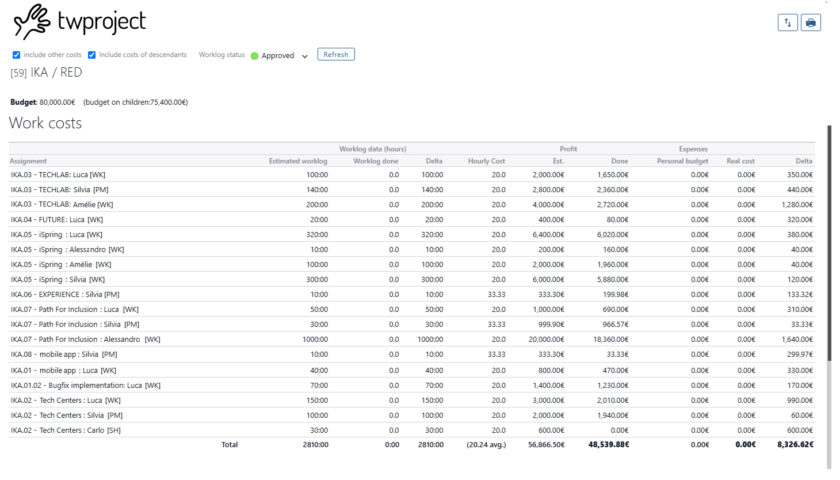
In short, each feature is designed to address a typical weakness in the management of budgeted projects: delays in information, scattered data, and the difficulty of comparing planned figures with actual results.
Twproject enables project managers and executives to move from reactive, retrospective monitoring to proactive monitoring, capable of identifying deviations as they occur, rather than when it is already too late to take action.
Innovation, research and external reporting: the Oberalp case study
Let’s look at a real-life example: the Oberalp Group. This clothing manufacturer, with over 850 employees and 12 global offices, manages long-term technical development projects, creative work using agile methodologies, and research initiatives co-funded by external bodies such as the European Union, all in parallel. For the latter, reporting hours and costs is a formal requirement, not a choice.
Before Twproject, Oberalp used seven different tools, none of which were integrated with the others. Cost control was fragmented, and gathering financial data for funding reports required a disproportionate amount of effort.
With Twproject, time tracking has become straightforward even for those who are not used to recording their hours, and financial data is always available in the right format for reporting. The result: seven tools reduced to one, with a level of financial transparency that was previously unattainable.
As the IT Business Excellence manager says:
In addition to the value offered by Twproject, another benefit is the reduction in maintenance costs resulting from the consolidation into a single solution.

Do you want to know the true cost of projects, in real time?
To sum up: if it takes more than thirty seconds to answer the question ‘What is the current status of the budget for this phase?’, there is a problem with the tools — not with the skills.
Our expert production tutors will set up Twproject for you based on the actual structure of your projects: budgets by phase, staff rates, cost-overrun alerts and reports ready for management or your clients. In a single session, you’ll see how it works for your specific situation, not just a generic example.
👉 Find out how much you could save: book a free personalised demo