

In a production company, a complex project is never the responsibility of just one department.
Design, procurement, production, logistics, quality: each phase involves different skills, different timelines, and different people in charge.
When the structure isn’t clear from the start, the team’s energy is scattered, and problems always seem to arise at the worst possible moment.
If this scenario sounds familiar because you’re struggling to keep the various teams aligned within a shared project, know that there are effective methods and tools to address the problem. Keep reading to find out more.
CONTENT
The good news is that there’s an approach that works, no matter how complex the project is. It’s called the Work Breakdown Structure, and with the right tools, it becomes a practical way to keep everything under control.
The term ‘Work Breakdown Structure‘, or WBS, refers to a process for hierarchically breaking down the work that the team must perform. The entire process is results-oriented and focused on deliverables, but it divides the project into manageable blocks that can be estimated and monitored (even) independently.
Unmanageable project? Maybe the problem is how it’s structured
Complexity isn’t the enemy. The problem arises when that complexity isn’t organised: a project where everyone knows there’s a lot to do, but no one has a clear picture of who does what, in what order, and by when.
To better tackle a complex project, the key is to break it down into phases and subphases using a Work Breakdown Structure (WBS), in order to transform a single, large objective into a series of manageable units.
Each phase has a beginning, an end, a person in charge, and clear dependencies on the preceding and subsequent phases. This doesn’t simplify the work itself, but it makes it easy to understand: and a project that’s easy to understand is a project that’s manageable.
Here is an example of what a WBS looks like for one of the projects of a production company:
- Phase 1 – Design (Engineering Department)
- Requirements Analysis
- Concept Development and Technical Specifications
- Internal Approval
- Phase 2 – Procurement (Purchasing)
- Request for quotes from suppliers
- Ordering materials and components
- Phase 3 – Production (Production Department + Quality)
- Equipment preparation
- Manufacturing and assembly
- Quality control
- Phase 4 – Delivery (Logistics + Engineering Department)
- Packaging and shipment preparation
- Delivery to the customer
- Testing and acceptance
How to build a WBS without leaving anything out
If you think that a WBS for projects might be a good planning method for your production company but are concerned that it might be difficult to implement, rest assured that with the right tools, you won’t have to worry about complications.
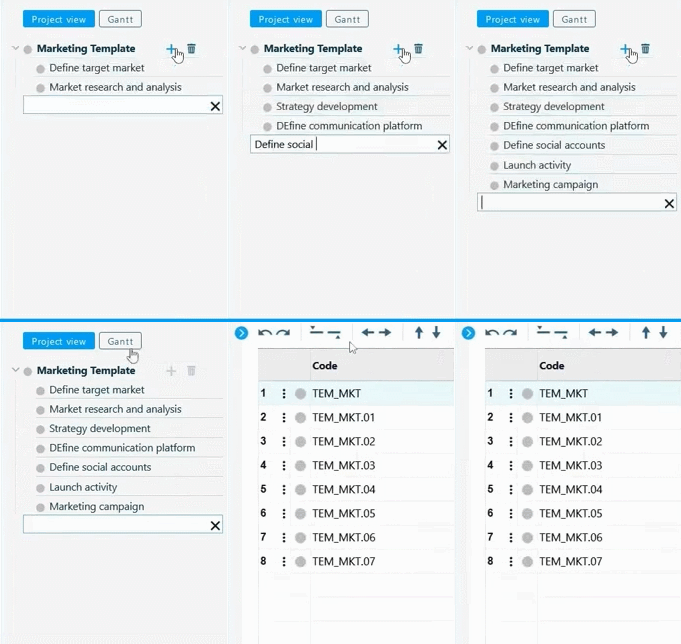
With Twproject, for example, the creation of the WBS is guided by structured, fillable fields: for each phase and subphase, you can define the name, description, duration, person in charge, budget, dependencies, and priority.
This structure is a great visual aid, but it also helps ensure that no relevant data is omitted, especially in complex projects where it’s easy to lose sight of the details during the intermediate stages.
But there’s more: if you use Twproject, one of the most popular project management platforms among production companies, you can quickly convert the WBS into a project Gantt chart.
In fact, the WBS and the Gantt chart are two complementary views of the same structure: you can create the WBS from the tree view and see it automatically converted into a Gantt chart, or work directly on the Gantt timeline and find that the hierarchical structure has already been updated.
On Twproject, these tools sync with each other in real time, eliminating the need for manual reconciliation.

How to avoid starting from scratch every time
In production companies that manage projects of a similar nature — same product type, same sequence of steps, same departments involved — rebuilding the WBS from scratch every time is a time-consuming task that adds no value.
Twproject lets you clone an existing project, or a phase of it, by replicating either its entire content or just the parts you need. If you manage recurring projects, this will allow you to:
- Keep or clear assignments
- Adjust the dates to fit the new context
- Copy any documents, costs, and ToDo’s
- Decide whether the copied structure will be independent or part of another project
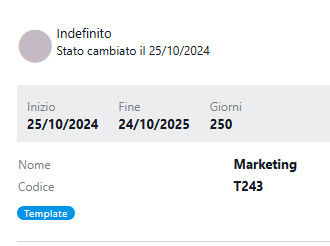
Alternatively, you can create actual project templates, i.e. predefined structures that have already been validated in practice and serve as the standard starting point for every new project of the same type. Over time, these templates are refined: every completed project provides an opportunity to improve the initial model and incorporate lessons learned.
When seasonality leaves no room for error: the Alpego case
Here is an example of a real-life case, based on an interview with Alpego, a manufacturing company that uses Twproject to organise and manage its projects.
At first, the company, a leading manufacturer of agricultural machinery, faced a recurring challenge: the highly seasonal nature of its business meant that any delay could have devastating consequences. Before Twproject, the lack of an integrated view of planning and actual results made it impossible to make accurate estimates.
Missing a season meant falling behind and jeopardizing long-term goals. For this reason, the technical department managers were looking for a solution that would provide a clear and integrated overview.
Using Twproject, Alpego has defined project structures with precise phases and clear deadlines, gradually expanding the tool’s use from the design phase to the industrialization phase. The result has been more accurate planning, better allocation of resources, and departments that are continuously aligned:
We defined the phases with clearly specified start and end dates, leaving nothing to chance. This allowed us to stay on schedule and get the support we needed.

The well-defined project structure, as this experience shows, also serves as the foundation for everything else: cost tracking [LINK], workload management [LINK], and real-time visibility [LINK], all of which are fundamental to project management in manufacturing companies.
Start with a pilot project rather than the entire company
Introducing a new way of structuring projects within your manufacturing company does not mean you have to change everything overnight. The most effective approach is to start with a representative project — a job order that reflects the typical complexity of your business — and set it up on Twproject with the support of an expert tutor in the sector.
Our tutors understand the specific challenges faced by production companies: seasonality, multiple departments, shared resources [LINK] and recurring projects. If you book a free demonstration, they will show you how to configure Twproject to match the actual structure of your production projects: WBS, templates, responsibilities and dependencies: with our help, you can set these up easily and tailor them specifically to your context.
👉 Speak to a production expert: book your free session