

For those working in the consultancy sector, securing a new client is just the beginning. The real challenge lies in managing client relationships over time in a structured way – from the initial contact right through to reporting on ongoing projects.
When this information is scattered across emails, spreadsheets and separate tools, there is a risk of losing valuable data, missing important follow-ups and coming across as unprofessional to clients.
INDICE
- How do you organise your customer database without losing any information?
- How can you manage the pre-sale phase without losing the deal?
- How can project data be efficiently shared with clients?
- Take a look at this real-life case: Advance
- So, do you want to see how this works with your order structure?
Today we will try to explain the most effective practices for tackling some of the key challenges in client portfolio management at consulting firms, and how to provide the team with practical tools to ensure they stay on track with their work.
How do you organise your customer database without losing any information?
First and foremost, maintaining a well-organised database of potential customers is the first step to take, and it requires a consistent approach that is adopted by the whole team.
Every detail gathered during initial contact — an expressed preference, a reference to a past project, a specific contact person — may prove invaluable in the future. But without the right tool, this information tends to get lost.
Twproject allows you to manage your customer database directly within the platform: you can add an unlimited number of contacts and external resources without requiring them to log in, meaning they are not counted against your licence quota.
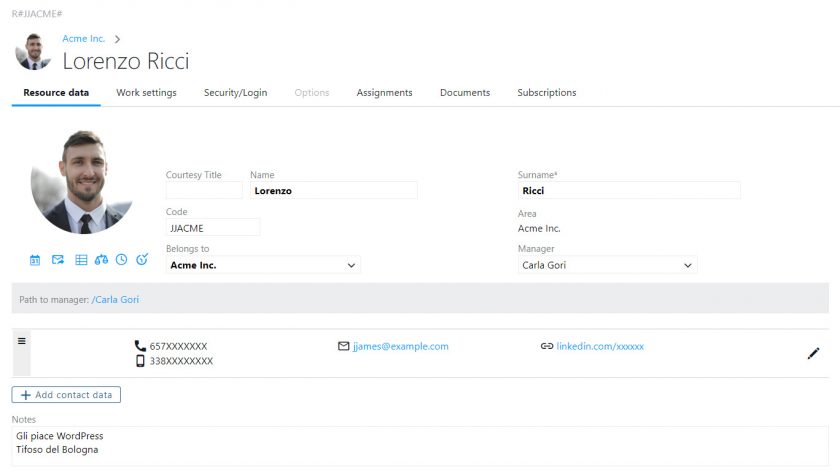
Contacts can be organized hierarchically—by company, department, or contact person—and grouped into work teams, making it easy to navigate even large client portfolios. Everything is tagable and searchable via full-text search: finding a conversation, document, or task related to a specific client takes just a few seconds, not hours of searching through emails.
How can you manage the pre-sale phase without losing the deal?
Another key issue is figuring out how to account for — and consequently report on — the pre-sales phase, and above all, ensuring that the entire team follows a standardized process.
The phase leading up to the formal launch of a project—exploratory meetings, proposals, negotiations, and estimates—is often the least documented. Yet it is during this phase that expectations, scope, and budget are defined: all factors will ultimately determine whether the project will be profitable or not.
With Twproject, you have a simple solution to this problem right at your fingertips: you can manage pre-sale tasks using ToDos. With Twproject’s advanced ToDos, each task includes:
- an assignee, i.e., the person handling the case, who can of course also assign it to themselves;
- an optional deadline;
- a priority level;
- any tags to identify, for example, the phase (pre-sale in this case);
- comments and mentions to keep everyone involved up to date;
- all related documentation, so you no longer have to search everywhere for the material.

Furthermore, the advantage of using ToDos over the features of a traditional CRM is that these tasks aren’t stored in a system separate from the rest: once the client signs off and the project kicks off, all the preparatory work is already within the same platform, ready to be transferred and reported on. You don’t have to start from scratch, you don’t lose the history, and everything is included in the project costs.
How can project data be efficiently shared with clients?
Once a project is underway, the client wants updates. Preparing them manually—extracting data, creating reports, and sending them via email—is a time-consuming task that adds no value.
And often the data comes in late, by which time the project has already taken a different direction. Twproject solves this in two ways.
- Integrated reporting: The platform monitors progress, costs, hours worked, and deviations from the plan in real time. Generating an up-to-date report is a simple process that you can perform from any project view, applying any filters you wish, and it requires no subsequent manual adjustments.
- The public project page: this allows you to give clients direct insight into projects. Clients access a public page where project information is compiled—which the PM selects from a list based on what they intend to share—and can track progress in real time. From the public page, the client can also send direct requests that automatically turn into ToDos, which the PM will then sort and assign to the relevant team members. All of this increases transparency, reduces requests for updates, and strengthens trust in the relationship between the agency and its clients.

Take a look at this real-life case: Advance
Advance is an IT consulting firm that manages a wide variety of projects simultaneously, ranging from software development to infrastructure implementation. Before Twproject, information about clients and projects was scattered across emails, Slack, and handwritten notes.
Since adopting Twproject, data and tasks have been centralized and are searchable in one place. In the words of the Managing Director:
All customer and project information is stored centrally and is easy to find; in doing so, we have created a searchable knowledge repository for the future.

The team has reduced the time spent on administrative aspects of customer management and can now focus on value-adding activities—without having to chase down data or updates.
So, do you want to see how this works with your order structure?
Managing customers, pre-sales, and reporting on a single platform isn’t complicated—as long as it’s set up correctly from the start—and it’s a best practice for achieving:
- Continuity of the customer relationship: Having a complete history of each customer means you don’t have to start from scratch with every new contact.
- Retention of all information: Details that seem irrelevant at first may prove useful later, so it’s important to be able to find them easily.
- Greater internal collaboration: When information is centralized, taking over a customer’s account is much easier in the event of staff turnover.
- Traceability of pre-sales activities: the hours dedicated to the sales phase can thus be included in the calculation of the project’s overall profitability.
- Transparency toward the client: shared reports and information allow you to respond accurately to client requests without having to reconstruct the data each time.
If you’d like to see how these processes apply to your consulting team, our tutors specializing in your field will show you Twproject configured to your actual workflow: client profiles, pre-sales activities, and client reports already tailored to your specific context.
👉 Book your free, personalized demo now


