

Consulting firms operate in a structurally different environment from any other organization: their primary product isn’t a physical item or software, but rather people’s time and expertise.
Each commission is a unique project, with a different client, specific objectives, and a team that often works on multiple assignments simultaneously.
As such, project management isn’t just an optional methodology it is the operational backbone of the entire company.
CONTENT
Why project management in consulting is different
In a manufacturing company or an in-house IT team, projects generally follow a sequential, if not strictly linear, workflow. In a consulting firm, however, the complexity is amplified: ten projects running simultaneously, shared resources across clients, overlapping deadlines, and out-of-scope requests that come in after a project has already started.
The project manager in this industry must therefore keep track not only of the progress of individual tasks, but also of the sustainability of the team’s workload, compliance with economic constraints, and client satisfaction.
It is not about managing a single project: it is about managing a portfolio of relationships and commitments, where every decision regarding one project has repercussions on the others.
The three main challenges
1. Real-time overview of schedules, costs, and resources
The first challenge is structural: in many firms, project information is fragmented across Excel spreadsheets, emails, and separate tools. The result is that problems always come to light when it’s too late—an overspent budget, an overworked team member, or a missed critical deadline—not because no one was working on it, but because no one had the full picture.
The answer to this challenge is portfolio management: a unified place to see all active projects, with filters for status, client, budget, and resources.
Tools like Twproject offer just that: a portfolio dashboard that isn’t just a list, but a tool that helps you identify problems and opportunities early on, and make informed decisions about where to focus your attention.
2. Scope control and overspending prevention
In fixed-price projects, where the team commits to delivering a specific result regardless of the hours required, the most treacherous risk is scope creep: extra client requests that pile up, eroding the margin and increasing the team’s workload, often without anyone noticing until the end of the project.
Managing scope in a structured way means planning the project on an interactive Gantt chart with stages, milestones, and dependencies, tracking every change from the original baseline, and making changes visible as they happen, not just at the end of the project.
In Twproject, for example, every extra request can be recorded as a To Do, tagged, and linked to the project phase it belongs to, making the history of scope changes and their impact on time and costs immediately clear.
3. Resource allocation and balancing
The third critical issue concerns internal and external resources. In a consulting firm, the same people often work on multiple clients at once. Knowing exactly who is doing what, their workload, and their deadlines at all times is essential to avoiding bottlenecks and burnout.
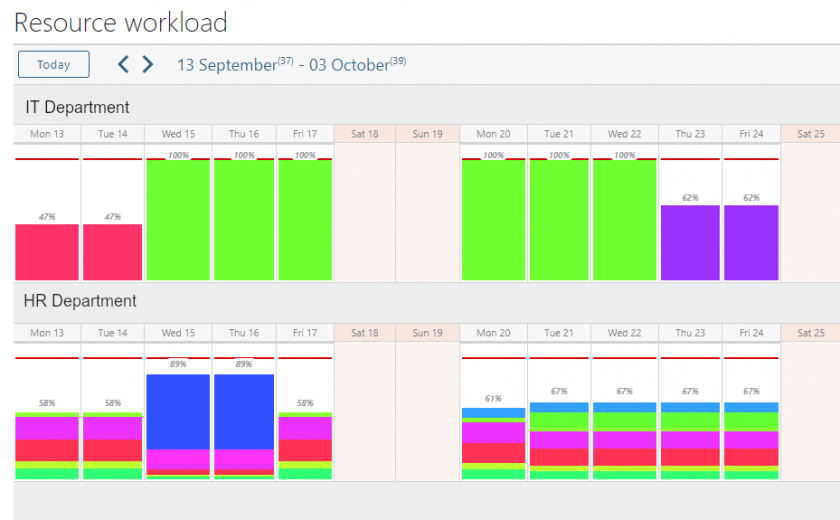
Resource management in consulting firms requires a tool that shows the actual workload in real time, distributes tasks phase by phase (not just by project), and helps the project manager to adjust priority sequences without having to call alignment meetings.
Twproject addresses this need with a workload view that automatically updates as resources report their hours worked—whether they are internal team members or external consultants and collaborators involved in individual phases.
Internal and external resources: integrated management
One aspect often overlooked in consulting project management is the distinction between internal and external resources and how they fit into the workflow. Internal resources have known availability, fixed costs, and can be monitored regularly.
External resources—such as freelancers, subcontractors, and partners—have variable availability, costs associated with specific deliverables, and often work on multiple client projects in parallel.
Managing both types of resources within a single system allows the project manager to have a realistic view of the overall workload, plan with adequate safety margins, and accurately report the actual costs of each project.
The role of the project manager in consulting
Project managers are not just planners. They are the link between customers, teams, and company leadership. They must translate customer expectations into concrete tasks, allocate work sustainably, monitor progress, and communicate transparently when changes occur.
To do this effectively, they require tools that integrate planning, resource management, and cost control into a single, unified environment—not separate systems that require hours of manual alignment.
Project management for consulting firms isn’t just a matter of method—it’s a survival necessity. Agencies that can keep their portfolios, scopes, and resources under control—in an integrated, real-time manner—enjoy healthier margins, less-stressed teams, and more satisfied clients.
Those who instead manage everything reactively—between Excel spreadsheets and emergency meetings—risk discovering too late where they are wasting time and value.
The good news is that there are tools designed to address this complexity, such as Twproject, a project management software tailored for consulting firms that integrates portfolio management, Gantt charts, resource management, and cost control into a single platform. Adopting them is often easier than it seems.