

Every trade has its own toolbox. Woodworkers have planes and chisels; surgeons have scalpels and precision instruments.
The project manager is no exception: to complete a project according to schedule, budget and expected quality, they need a specific set of tools, methodologies, and skills.
But what, exactly, should be in this toolbox? More importantly, how do you choose the right tools from the thousands of options available on the market?
In this article, we’ll cover everything a project manager should have at their disposal, from software tools to soft skills.
CONTENT
- The Project Manager’s Toolbox
- 1. Planning: the Gantt chart
- 2. Resource Management
- 3. Cost and Budget Control
- 4. Time Tracking
- 5. Agile methodologies: Kanban and Sprints
- 6. Dashboard and statistics
- 7. Communication and collaboration
- 8. Soft Skills: the invisible tools
- Why Twproject is a must-have in your toolbox
The Project Manager’s Toolbox
1. Planning: the Gantt chart
No project manager’s toolbox is complete without a visual planning tool.
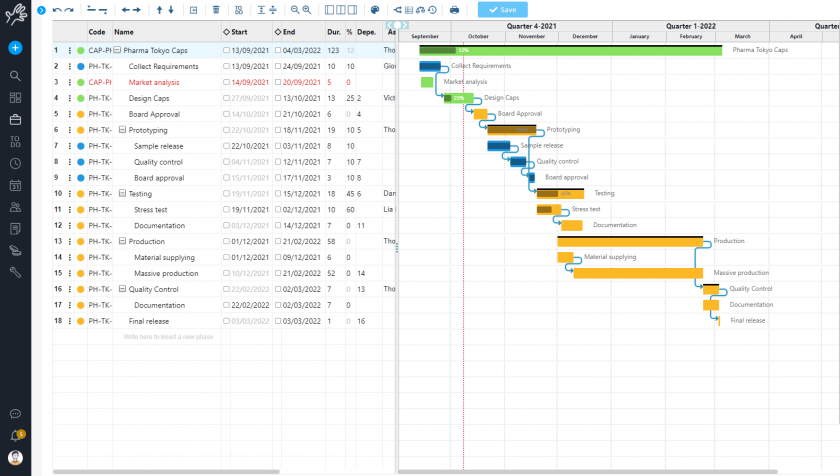
The Gantt chart is arguably the most iconic tool in project management: it allows you to graphically represent all project tasks on a timeline, along with their dependencies, deadlines, and responsibilities.
A good Gantt chart isn’t just a sketch on a piece of paper: it must be interactive and dynamic, capable of updating in real time as the project progresses.
Twproject offers an advanced Gantt chart, integrating schedules, workloads, and tasks into a unified overview. It allows you to drag bars to reschedule, view dependencies between tasks, and always keep the project’s progress under control. It is not a simple static display, but a fully functional operational tool.
Why it is essential: without visual planning, the risk of losing track is very high. A Gantt chart is your project’s compass; without it, you’re just sailing blind.
2. Resource Management
A project does not consist solely of tasks; it consists of people. One of the most critical skills of a project manager is knowing how to manage human resources—knowing who does what, when, and how busy they are.
Resource management requires a tool that shows the workload of every team member, flags bottlenecks and gaps, and allows tasks to be assigned or reassigned with ease.
With Twproject, the resource management module provides a clear picture of team usage: every resource, every project, and every commitment is visible in a single dashboard. This allows project managers to make informed decisions without having to chase people down or cross-reference countless Excel spreadsheets.
Why it is essential: delays in most projects aren’t caused by technical issues, but by poor resource management. Full visibility into the team is a massive competitive edge.
3. Cost and Budget Control
A project delivered on schedule but over budget is a failed project. That’s why a project manager’s toolkit must include a financial tracking tool: planned budget, actual costs, and variances.
Monitoring costs granularly — by task, by phase, by resource — allows you to take action early when something goes wrong, rather than discovering it only after the project is complete.
Twproject helps you keep costs and revenues in check throughout the project. You can compare your planned budget with actual costs, set alerts, and access constantly updated financial reports. A tool designed not only for project managers, but also for contract managers and CFOs.
Why it is essential: without financial control, project managers operate blindly regarding one of the most critical variables of any project.
4. Time Tracking
Knowing how much time is truly spent on each activity is crucial for two reasons: improving future estimates and accurately reporting on the work completed, both internally and to clients.
Time tracking should not be viewed as a means of control, but as a tool for precision: real data on which to build more realistic project plans.
Twproject natively integrates a time tracking and timesheet system that makes it easy for team members to record the hours worked on each task. The data automatically feeds into project statistics, eliminating double entry and reducing errors.
Why it is essential: without data on time actually spent, any future estimate will be pure guesswork. Time tracking transforms experience into measurable knowledge.
5. Agile methodologies: Kanban and Sprints
Project management is not one-size-fits-all. Some projects are suited to a waterfall approach, while others require flexibility and rapid iterations. In these cases, agile methodologies, with their incremental approach, are the way to go.
The Kanban board is one of the simplest and most effective visualizations: tasks move between columns (to do → in progress → completed) and the team always maintains a clear understanding of what is happening.
Twproject supports both traditional project management and the Agile and Kanban approach, providing the option to organize sprints, monitor the backlog, and track progress iteratively. A single tool for different methodologies: the flexibility every modern team needs.
Why it is essential: in a fast-changing world, inflexibility kills projects. Every team should have the luxury of having a tool that supports both Waterfall and Agile.
6. Dashboard and statistics
A skilled project manager must be able to quickly shift focus from operational details to the strategic vision. Dashboards and statistical reports are a project manager’s magnifying glass: they provide an overview of the status of all projects in the portfolio at a glance, help identify critical issues, and enable data-driven decision-making.
Twproject provides advanced statistics and portfolio dashboard that show project progress, key KPIs, cost trends, and anomalies in real time. You no longer need to manually aggregate data from different sources: everything is already there, up-to-date, and easy to read.
Why it is essential: without a big-picture view, a project manager risks being perpetually in crisis mode—as soon as one fire is put out, another ignites. Dashboards turn reactivity into proactivity.
7. Communication and collaboration
Tech tools alone aren’t enough. A successful project requires smooth communication among all those involved: teams, stakeholders, clients, and suppliers. Project managers must be able to clearly convey objectives, priorities, issues, and decisions.
Twproject makes collaboration a breeze with built-in features like task comments, automatic notifications, and document sharing. Every bit of info is right where you need it: instead of digging through thousands of emails, the team can find everything right in the task or project card.
Why it is essential: Fragmented communication is one of the primary causes of project failure. By centralizing information, you can minimize misunderstandings and increase accountability.
8. Soft Skills: the invisible tools
So far, we’ve focused on software tools. But a project manager’s toolkit also includes personal skills that no tool can replace:
- Situational leadership: know how to adapt your leading style to the team and the situation.
- Risk management: anticipate risks and have mitigation plans in place.
- Negotiation: find acceptable solutions for all parties involved (teams, customers, sponsors).
- Problem solving: when something goes badly (and it will), know how to analyze and resolve the situation without losing your cool.
- Change management: projects change. Knowing how to manage scope changes without losing control is an art.
Soft skills cannot be bought—they must be developed. However, with the right tools, you can enhance them: a project manager who doesn’t have to waste time collecting data or chasing updates has more mental bandwidth to focus on leadership and strategy.
Why Twproject is a must-have in your toolbox
We could use a different tool for every need: one for Gantt charts, one for time tracking, one for costs, and one for communication. This fragmentation, however, comes at a very high cost in terms of time, synchronization errors, and complexity.
Twproject was designed to be a one-stop solution: a single software platform that integrates planning, resource management, cost control, time tracking, agile methodologies, and reporting. Available both on-premise—for those who want total control over the infrastructure—and cloud-based, for those who prefer a turnkey service.
Many companies worldwide have adopted it — from Calzedonia to DHL, from Deloitte to Zucchetti — across sectors ranging from manufacturing to IT, from engineering to marketing. Its flexibility makes it suitable for teams of all sizes and various methodologies.
If you haven’t found your dream project management software yet, give Twproject a try for free or request a tailored demo.


