
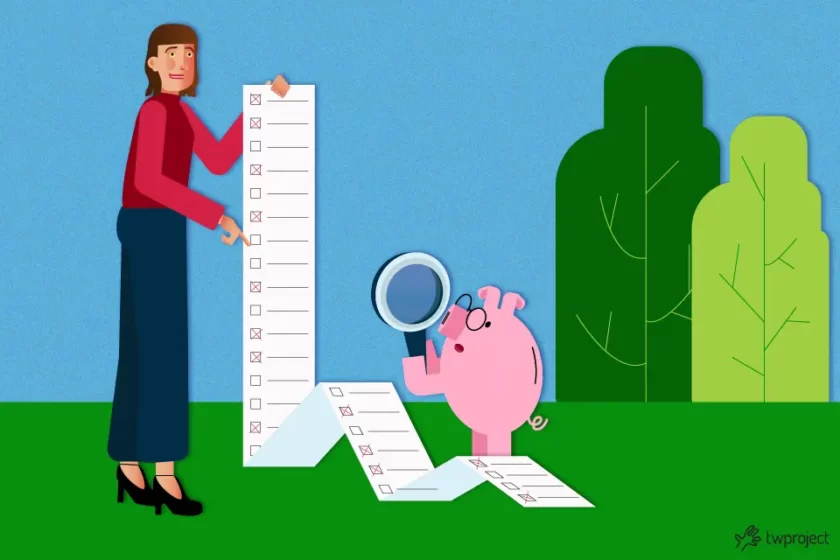
The punch list is arguably one of the most practical tools in a project manager’s toolbox during the closing phase of a project, when their job is to make sure that everything promised has actually been completed to the highest standards.
It is a complete list of discrepancies, unfinished work, or flaws found during the final inspection – aspects that must be corrected before the project is formally closed and the client gives final approval.
What we’ll cover in this article: We’ll first define what a punch list is, then explore its purpose during the closure phase, how to create and manage the items on a punch list, and why this tool is particularly important in the engineering and plant construction sectors. We’ll wrap up with some operational best practices and a practical example applied to an EPC project.
CONTENT
What is a punch list?
This term originates from the construction industry: in the past, inspectors would physically “punch” each completed line on a paper form, thus giving rise to the name.
Today, a punch list is a shared document, often digital, that lists all nonconformities identified during the final inspection, before the final handover of the project or work.
How it is used when closing a project
In the closing phase, the project manager must ensure that the final deliverable precisely matches what was specified in the contract.
The punch list therefore becomes the link between the project’s effective completion and its formal acceptance: until the items on the punch list are taken care of, the final payment may be withheld, and the project cannot be considered fully wrapped up. It is a tool that benefits both the client, who receives work that meets specifications, and the contractor, who has a clear and well-defined list of remaining tasks to complete.
Punch lists and checklists: what’s the difference?
Punch lists and checklists aren’t exactly the same thing.
A checklist typically consists of predetermined items. For example, when closing out a project, it might include verifying documents, the budget, approvals, and the delivery of deliverables.
On the other hand, a punch list is generally based on what comes up during the final inspection.
In other words, a checklist specifies what needs to be verified, while a punch list lists what still needs to be fixed.
Managing punch lists with project management software
When you have many tasks to address, using Excel spreadsheets, paper worksheets, or long email chains can often make it difficult to understand the actual status of the project’s closure.
Project management software like Twproject, can transform items on your punch list into actionable tasks by linking them to the project, assigning responsibilities, and tracking their progress.
With Twproject, you can organize tasks and responsibilities, track deadlines and progress, and centralize project-related documents. This platform also allows you to combine tools such as tasks, to-do lists, Kanban, Gantt and document management.
The main benefit is that the punch list isn’t kept separate from the rest of the project, it becomes part of your team’s regular workflow.

The construction punch list in engineering and EPC projects
This tool is especially critical in engineering, particularly EPC (Engineering, Procurement, and Construction) projects. Here, often referred to as a punch list or construction punch list, the acceptance checklist can include hundreds, sometimes thousands, of items spanning multiple areas: mechanical systems, electrical systems, instrumentation and control, civil works, insulation, and painting.
Unlike a traditional construction site, an EPC project involves dozens of specialized subcontractors working simultaneously, each responsible for a different part of the facility, which makes the collection and assignment of nonconformities a coordination task that is anything but trivial.
In these projects, the punch list is typically broken down by phase: it begins with mechanical completion, when physical work is finished but not yet tested; continues with pre-commissioning, during which individual systems and circuits are verified; and finally ends with the actual commissioning, when the plant is brought online at full capacity.
Each phase generates its own list of nonconformities, and their subsequent closure is often a binding contractual requirement for moving on to the next step.
The financial relevance of this process in EPC projects is therefore far greater than in a typical construction project: a delay in resolving even a few items can halt the plant’s commissioning and postpone the start of production, with significant financial consequences for the end customer.
This is not just a matter of contractual penalties, but often involves lost revenue for each day of delayed startup, as well as the additional costs of on-site personnel for the engineering teams and subcontractors involved in addressing any remaining irregularities.
Best practices for using a punch list successfully
A few rules can make management considerably easier: get all disciplines involved as early as the intermediate inspections, not just at the end of the project; centralize your checklist in a single shared tool, so you don’t have Excel spreadsheets spread across different teams; set realistic deadlines for each item; and formally close out each item only after a combined check by both the team that performed the work and the client.
Think of an engineering project to build a new production facility. Your team might identify about ten nonconformities during final testing: a valve that isn’t properly tightened, some wiring that needs to be labeled, a control panel whose alarm isn’t calibrated.
The project manager would then add each item to the punch list, assign responsibility to the respective subcontractors, and set a deadline of five business days. Only after all critical items are fixed can the plant be formally handed over to the client.
Structure-based management of the punch list—especially in the complex projects typical of engineering and EPC—lowers the risk of claims, speeds up receipt of the final payment, and closes each project with the certainty that the delivered work truly complies with what was agreed upon.