

Workloads in a technical office are often the ultimate indicator of an engineering company’s health: when they are not distributed thoughtfully, they quickly snowball into project delays, rushed drawings, and superficial reviews—all of which directly impact project quality and safety.
In the technical offices of engineering and EPC (Engineering, Procurement, and Construction), this problem becomes even more critical than in other contexts: an overwhelmed structural engineer can’t just “deliver less”; they also risk mistakes in calculations, regulatory omissions, or inconsistencies across disciplines (civil, electrical, mechanical, and MEP) that must work seamlessly together in complex projects.
CONTENT
- Why is the technical office a highly prone environment for imbalance
- The role of project management in the technical office
- Monitor in real time, not after completion
- How to manage your workload in a structured way
- The link between time management and project quality
- A process, not a one-time effort
In this article, we’ll discuss why the engineering department is prone to this type of imbalance and what role proper project management plays in preventing it. We’ll also explore why monitoring workloads in real time, rather than only after completion, can make the difference between a team that meets deadlines and one that falls behind.
Why is the technical office a highly prone environment for imbalance
Unlike other departments, the technical office often works on multiple projects at the same time, with deadlines set by the client, the construction site, or regulatory bodies.
Every designer, CAD/BIM drafter, or structural engineer may be assigned to two, three, or more projects in parallel, each with different priorities and overlapping deadlines.
In this context, understanding how much work is actually assigned to each person is not just paperwork: it is essential for understanding where a bottleneck is about to form before it becomes an operational concern or, worse, a design error that only surfaces during construction. In many cases, in fact, the amount of work assigned to a single engineer is decided without truly considering their existing workload. The typical risk is twofold.
On the one hand, the most experienced engineers (those the project manager “knows they can count on”) usually end up with more assignments than others, simply because they require less revision.
On the other hand, junior staff are left with available resources that remain underutilized. The result is a persistent imbalance that, over time, produces two opposing but equally harmful effects: burnout among senior staff and limited professional growth among junior staff.
The role of project management in the technical office
Successful project management in technical and engineering fields cannot be accomplished without a holistic perspective of all active projects.
It is not enough to know “who is doing what” on a single project; you need to know how much time—in hours or man-days—each person has already spent on all ongoing projects. Only with this big-picture view is it possible to allocate resources in a way that aligns with the required skills (structural analysis, mechanical and electrical design, working drawings, construction supervision) and with the contractual deadlines for each project.
The planning process should always begin with a simple yet often overlooked question: How long does it take to complete each design phase, from the preliminary phase through the working drawings to final approval?
Without a reasonable estimate, any assignment of tasks risks being based on subjective perceptions rather than factual data. And this is exactly where many engineering departments fall short: they continue to assign work “by gut feeling,” relying on a technician’s apparent availability rather than their actual remaining capacity.
Monitor in real time, not after completion
One of the most common mistakes in technical offices is assessing workload only after work has been completed, by which time a designer has already fallen behind on multiple fronts.
The difference between a technical office that operates efficiently and one that struggles often lies in the ability to monitor workloads in real time, so that action can be taken before imbalances become apparent in delivery schedules.
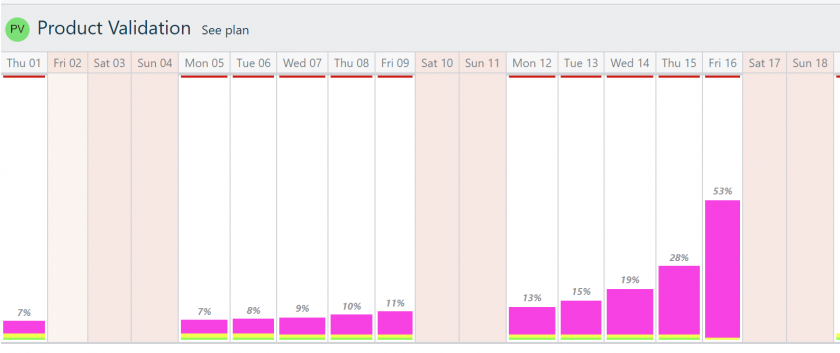
A good project management tool provides an overview—at a glance—of how many hours each person has already allocated to various projects, what the upcoming deadlines are, and where a workload overload is about to occur.
This type of continuous monitoring is especially useful during hectic times, which are typical in the engineering industry: the delivery of a technical layout, the launch of a major new project, or an urgent revision requested by a client can upset the balance of an entire team in just a few hours.
Without a tool that dynamically updates data, there’s a risk that the project manager will only spot the imbalance when it’s already too late to correct it.
How to manage your workload in a structured way
Managing workloads in a technical office requires an approach that combines three elements: skills, availability, and project priorities.
Here are some best practices that a technical project manager should adopt:
- Map out each team member’s unique skills, identifying who can handle structural analysis, who can handle mechanical and electrical design, and who can handle construction drawings, while avoiding generic assignments that do not take actual specializations into account.
- Regularly check the available resources for each active project, so as to identify possible margins for flexibility—or, conversely, impending overloads—in a timely manner.
- Apply flexibility in planning,without ever assigning a technician to 100% of their working capacity, to make room for revisions, urgent client requests, or unforeseen issues on the job site.
- Communicate openly with your team, because each team member is directly involved in their own workload and can support, and sometimes correct, the data collected by planning tools.
One aspect that is often underestimated is that workload cannot only be measured in assigned hours: two tasks of the same duration can be quite different in terms of cognitive complexity. An hour spent verifying a critical structural calculation requires a significantly different level of focus than an hour spent updating a standard drawing.
An experienced technical project manager takes this qualitative variable into account as well, not just the quantitative one.
The link between time management and project quality
In a technical office, time management isn’t just a matter of staying on top of deadlines: it’s directly linked to the technical quality of the output.
A designer working under constant pressure, with multiple overlapping projects, could end up skipping verification steps that they would normally never miss.
In the engineering industry, this can translate into sizing errors, discrepancies between drawings and calculation reports, or a failure to cross-check between different disciplines—errors that, if discovered on-site, will generate correction costs far higher than those that could have been avoided during the design phase.
For this reason, workload management within the engineering department must be regarded as a full-fledged quality control tool, not just an organizational one.
A well-balanced workload gives engineers the necessary breathing room to perform the checks required by the design process, allowing them to organize their work in an orderly manner and drastically reducing the likelihood of costly errors that must be corrected later on.
A process, not a one-time effort
Workload balancing must be an ongoing process, not a task to be performed only when the first signs of a crisis become apparent.
The planning process should be reviewed on a regular weekly basis during periods of peak project activity, comparing initial estimates with the actual progress of tasks.
Only in this way you can identify deviations early on and take action before they become irreversible.
Investing in tools like Twproject that help you monitor workloads dynamically, along with a managerial approach that focuses on both quantitative data and qualitative feedback from the team, is what sets a technical department capable of managing complex projects without sacrificing quality and safety apart from one that is constantly operating in crisis mode.