

The project buffer is one of the most powerful—and underrated—tools in modern project management. When a project suffers delays, it is rarely due to a single event: it is the result of dozens of micro-delays that multiply throughout the sequence of activities, silently eating away at every available safety margin.
Even so, most teams still deal with delays reactively, finding out about them only when it’s too late to take meaningful action.
In this article, we’ll cover what a project buffer is, how the critical path works, and how Twproject lets you manage these mechanisms in a structured way to ensure a project is completed on schedule.
CONTENT
- What is a project buffer and why is it crucial?
- Critical Chain and activity Sequence: How to Build a Buffer
- Buffer management: real-time consumption monitoring
- Why projects accumulate delays: the most common causes
- How Twproject supports project buffer management
- Project buffers and safety margins: an important distinction
What is a project buffer and why is it crucial?
In project management, a project buffer is a strategically placed, planned time cushion at the end of the critical chain—the longest and most constraining sequence of activities that dictates the overall duration of the plan. Unlike traditional safety margins hidden within each task, the project buffer concentrates all the protection in a single, visible, and measurable point.
This approach stems from Critical Chain Project Management (CCPM), created by Eliyahu Goldratt in the ’90s. The concept is simple: if each task includes an “inflated” estimate to account for uncertainty, the extra time will likely be used up anyway—whether due to Parkinson’s Law or the “student syndrome.” Consolidating everything into a single time buffer at the end of the critical chain radically changes these dynamics.
| Rule of thumb: The project buffer is not an emergency “safety net”—it is an active planning tool that helps project managers always know how much breathing room they have left. |
A project without an explicit buffer is, essentially, a project without any real protection: any delayed task directly impacts subsequent tasks, and the project manager finds themselves having to make constant last-minute adjustments.
Critical Chain and activity Sequence: How to Build a Buffer
To calculate your project buffer, you first need to determine your critical chain: the longest sequence of activities that includes not only the logical dependencies between tasks but also resource constraints.
This separates it from the traditional critical path (CPM), which considers only dependencies. After you’ve identified the critical chain, the project buffer is typically calculated using one of these methods:
• Cut and Paste (50%): 50% of the total duration of the critical path is used as a buffer
• Root Square Error Method (RSEM): Here you need to calculate the square root of the sum of the squares of the uncertainties for each activity
• Statistical method: Probability distributions are used to estimate cumulative risk.
Alongside the critical path, the activities that contribute to it (referred to as “feeder chains”) also need their own time buffers to prevent their delays from causing delays in the main sequence. The key difference is that these buffers cannot be consumed internally, but instead act as buffers before the secondary activities connect to the critical path.
| The critical chain is not fixed: it varies depending on the available resources. Recalculating it periodically is a key part of effective buffer management. |
Buffer management: real-time consumption monitoring
Having a planned project buffer is not sufficient: you need strict buffer management—that is, a system to continuously monitor how much buffer is being consumed relative to the project’s actual progress.
The typical tool is the “fever chart”: a graph that correlates the percentage of buffer consumed with the percentage of the critical path completed. The three alert zones (green, yellow, and red) show the project manager when it’s time to take proactive action.
• Green zone (0–33% buffer consumed): the project is proceeding as expected; no action is needed
• Yellow zone (33–66%): buffer consumption is above average; it’s time to prepare to take action
• Red zone (over 66%): the safety margin is nearly used up; immediate action is required
This approach makes it possible to separate structural problems from one-off issues: a spike in buffer consumption may be normal at certain points in the project, but a steady trend toward the red zone is a clue that the original plan needs to be revised.
Effective buffer management turns delay management from reactive to predictive. We can be certain that without this kind of visibility, many project managers discover problems too late to take meaningful action.
Why projects accumulate delays: the most common causes
Before using any tool, it’s worth understanding why projects tend to run over budget. The causes are often systemic and recur regardless of the industry or the size of the organization.
• Overly optimistic estimates: Every manager tends to underestimate the complexity of their work
• Resource multitasking: A resource shared among multiple projects can cause a chain reaction of delays in both
• Unmanaged dependencies: When one delayed task prevents others from starting, it creates a domino effect throughout the workflow.
• Delayed communication: The delay is reported only after it has set in, limiting the options for catching up
• Lack of explicit buffers: Without a visible safety buffer, any delay directly affects the final delivery date
All of these factors contribute to a well-documented trend: projects almost always run behind schedule compared to original plans, unless there is a structured system in place for protection and monitoring. A project buffer, managed systematically, must be an integral part of this system.
How Twproject supports project buffer management
Twproject is the project management platform that incorporates all the tools needed to plan, monitor, and safeguard your project timeline —including structured time buffer management—into a single system.

With Twproject, a project manager can:
• Get a clear view of the sequence of activities on an interactive Gantt chart with real-time dependencies;
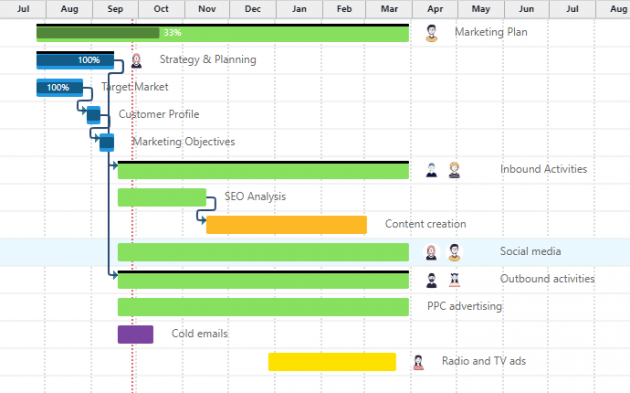
• Identify the critical path by viewing dependencies and resource loads;
• Set explicit time buffers as milestones or dedicated phases, accessible by all team members;
• Monitor work progress (SAL) to calculate buffer consumption against actual completion;
• Get automatic alerts when tasks on the critical path experience delays that exceed specified thresholds;
• Manage resource loads to prevent multitasking that causes cascading delays.
The workload management module in Twproject also gives you the insight to see in advance where resources will be overloaded, allowing you to redistribute your workload before the issue impacts your critical path. This is one of the most effective ways the platform helps prevent delays.
Twproject’s user interface is designed for teams working on multiple projects simultaneously: the centralized dashboard provides a buffer-based overview of each project’s health, making it easy to immediately identify critical issues. A project without buffer visibility is a project that accumulates delays unnoticed—exactly what Twproject is designed to prevent.
Project buffers and safety margins: an important distinction
It is common to mistake the project buffer for the typical safety buffer that many project managers include in their estimates. The difference is significant.
The conventional safety buffer is spread across every single task; it is invisible and untraceable. It is quietly consumed, often for reasons unrelated to the task’s actual uncertainty. As a result, when a serious problem occurs, the margin has already been depleted.
The project buffer, in contrast, is explicit, centralized, and measurable. It is part of the project as a whole, not of individual tasks. This fundamentally changes the team’s behavior: tasks are completed as soon as possible (eliminating the “procrastination syndrome”), and the safety margin is preserved for when it is truly needed.
In a well-implemented critical chain environment, the project buffer makes the difference between a plan that withstands uncertainty and one that passively accepts it. When applied effectively, it can reduce project completion delays by 20–30% compared to traditional methods.
Managing a project without an explicit buffer means relying on chance. When properly planned and effectively monitored through robust buffer management, the project buffer is the tool that turns delay management from a chronic problem into a controllable variable.
The logic of the critical chain provides a rigorously structured framework for building realistic plans, protecting the sequence of activities from unforeseen events, and taking early action when the safety buffer begins to wear away.
Managing the project buffer is easier with Twproject because all information is centralized: tasks, deadlines, dependencies, workloads, progress, and costs.
Completing a project on schedule doesn’t happen by chance—it’s the result of smart planning and continuous monitoring.


