

Management control is often seen as a merely accounting process, something to deal with at the end of the month or quarter to make sure the numbers add up.
In reality, when properly set up, it becomes one of the most powerful tools managers have for navigating business strategies and keeping their company on track toward its goals.
In this article, we’ll break down what it really means to improve management control, which aspects need attention, and how to make it a daily ally in the decision-making process.
CONTENT
- What is management control and why it’s more than just accounting
- Key principles of effective management control
- Cost accounting and data analysis: building blocks of control
- Regular reports that truly work
- From monitoring to corrective actions: the decision-making process
- Management control in the manufacturing industry
- 3 common mistakes in management control operations
- Management control: who should take care of it?
- 3 common mistakes in management control operations
What is management control and why it’s more than just accounting
Management accounting is the group of processes, tools, and metrics that help measure a company’s performance compared to planned goals, promptly identify variances, and take action before they become a structural problem.
Management accounting should not be mistaken for general accounting, which merely records past events: management accounting, on the other hand, must look ahead, providing management with a regular overview of the company’s economic and financial health.
Many companies, particularly rapidly growing medium-sized ones, realize that their management control systems have remained stuck in a primitive stage: Excel spreadsheets unrelated to one another, delays in data collection, and indicators that vary from one department to another.
As a result, decisions are made based on partial or outdated information, which directly impacts the company’s ability to respond in a timely manner to declining profit margins, production delays, or cash flow pressures.
Improving management control means, first and foremost, bringing order and timeliness back to the way data is collected, processed, and reported to decision-makers.
Key principles of effective management control
Building a genuinely useful management control system requires attention to several fundamental components that must be consistent with one another and not managed as separate entities.
The first key element involves defining clear and measurable business objectives, that are cascaded from top management to individual departments or projects. Without a benchmark, any data collected loses its meaning: knowing that a project cost 80,000 euros says nothing unless it is compared to the projected budget.
The second key element concerns metrics: each business unit should monitor a limited number of truly meaningful KPIs, avoiding the temptation to measure everything without then having to analyze anything. It’s better to have a few indicators tracked consistently than overloaded dashboards that no one really checks.
The third cornerstone is how often checks are conducted. Management control must incorporate regular review periods—for example, monthly or quarterly—during which results are compared to the budget and any corrective actions are decided upon. A review conducted just once a year, during the financial statement preparation phase, always occurs too late to be truly useful.
Cost accounting and data analysis: building blocks of control
There is no effective management control without solid cost accounting. While general accounting provides an overview of the company’s overall situation, cost accounting provides a detailed breakdown: by project, cost center, product line, or customer.
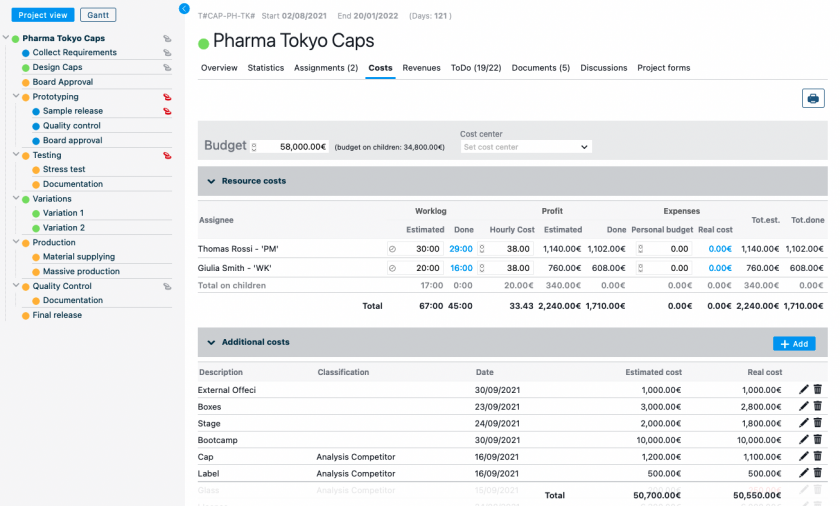
The granularity offered by cost accounting is what makes it possible to truly understand where a company is generating profit and where, on the other hand, it is losing profit without realizing it.
A well-structured cost accounting system is the backbone of any meaningful data analysis. If you don’t have clean, consistent, and up-to-date data, even the most powerful control system will only yield unreliable numbers. This is why, before investing in software or advanced dashboards, many companies should take the time to review how costs and revenues are categorized across their business operations, ensuring that each item is allocated to the correct responsibility center.
Data analysis, therefore, serves as the bridge between raw numbers and operational decisions. Reporting alone is not enough: you must know how to interpret your data, identify the most significant variances, and understand which ones require immediate action and which can be monitored over time.
Regular reports that truly work
One of the most common mistakes is confusing reporting with management control itself. Reports are a tool, not the end goal. Effective monthly or quarterly reports must answer a few specific questions, such as: Are we in line with our budget? Where are the main deviations? What corrective actions have already been taken, and what has been their effect?
A good report must be concise, easy to read even for those without accounting expertise, and must reach decision-makers in time for them to take action. A thirty-page document submitted three weeks after the end of the reporting period serves no one, no matter how accurate it may be. A streamlined dashboard, updated regularly, is far better, as it allows you to grasp the trends in key business performance metrics at a glance.
From monitoring to corrective actions: the decision-making process
The real benefit of management control shines when the collected data translates into tangible decisions. A control system that merely flags a deviation without triggering a structured decision-making process is of little use: it identifies the problem but does not help solve it. For this transition to take place effectively, it is worth setting thresholds in advance: when a deviation exceeds a specified threshold, an automatic review with the responsible manager should be triggered. This approach enables faster decision-making, preventing problems from being discussed only during scheduled quarterly meetings. Effective control management also requires that corrective actions be tracked over time: who proposed them, when they were implemented, and what effect they had on subsequent results. This helps build an organizational record that makes each control cycle more refined than the previous one. To better understand how these principles apply in practice, it can be beneficial to examine a typical case from the manufacturing industry. A metalworking company that operates on a contract basis, with around twenty active projects at any given time, often faces cost overruns only after completion, by which point there is no longer any room left for adjustment. In this case, improving management control involves, above all, implementing a time tracking system to keep track of hours and materials assigned to each project in real time, rather than at the end of the month using paper forms. The second step involves introducing a biweekly interim review of the highest-risk projects, with alert thresholds based on the variance between actual costs and budgeted costs. The most noticeable result was not only an improvement in average profit margins but, above all, the possibility for project managers to take targeted corrective actions (renegotiating delivery times, reallocating resources, revising the estimate with the client) before a variance turned into a full-blown loss. A project management system like Twproject, used in production and manufacturing settings, makes it possible to link project planning with real-time cost monitoring, simplifying this type of precise control. Modern management control can’t rely entirely on spreadsheets. There are dedicated software tools that automate data collection, minimize manual errors, and provide decision-makers with the information they need in real time. Twproject, for example, provides the option to create a budget and make realistic forecasts by directly tying project planning to actual cost tracking, ensuring a constantly updated economic and financial overview without having to chase down data scattered across different departments. Activity monitoring also plays a pivotal role: being able to know at any given moment the status of ongoing business activities, who is working on what, and where the bottlenecks are, directly feeds the control system with up-to-date data, preventing management control from relying on information that is weeks old. Good software does not replace the skill of those who analyze the numbers, but it frees up valuable time that would otherwise be spent manually collecting and reconciling data—time that can be invested in proper analysis and discussions with operational managers. A common mistake, particularly in medium-sized companies, is to regard management control as the exclusive domain of the management team. To ensure the system truly functions effectively, however, involvement must extend to department heads, project managers, and—in more structured organizations—a dedicated controller who serves as a bridge between the numbers and operational decisions. The controller or management control manager does more than just generate reports: they must translate data into operating guidelines that are understandable to those managing day-to-day business operations. This requires close collaboration with department heads, who are often the first to spot signs of variances even before they appear in the consolidated figures at the end of the period. Senior management also plays an active role: a corporate management control system works only if those leading their business actively use it to guide corporate strategies, rather than relegating it to a formal requirement to be consulted only occasionally. When top management leads by example—by integrating management control data into strategic meetings and investment decisions—the rest of the organization naturally tends to follow suit, reinforcing a data-driven culture at all levels. When improving management control processes, certain mistakes happen with some regularity. The first is excessive complexity: developing dozens of highly detailed indicators and reports can seem like comprehensive oversight, but it often backfires, diverting attention to irrelevant details and slowing down the decision-making process instead of speeding it up. The second mistake is a lack of consistency: you might enthusiastically roll out a new control system only to then ditch it after a few months—perhaps because it requires more effort than expected to collect data. Management control must be sustainable over time; otherwise, it loses all value. Lastly, a third common mistake is isolating management control from the rest of the business processes, dealing with it as a separate endeavor rather than as an integral part of planning and project management. When management control interacts with operational planning, however, it becomes a tool that guides day-to-day decisions, not just a retrospective assessment of the results achieved. Improving management control is not a one-off project, but a continuous process that requires discipline, appropriate tools, and, above all, commitment to turning data into decisions. Management control must be built on clear business objectives, supported by reliable cost accounting, and delivered through straightforward and timely reports, whether monthly or quarterly. The real leap in quality takes place when management control ceases to be a retrospective exercise and becomes an integral part of the daily decision-making process: only in this way can a company effectively react to variances, correct courses before problems escalate, and constantly align its business strategies with actual results. In this regard, a well-designed control system must be regarded as an investment, not a cost: it is what enables an organization to make informed decisions rather than simply reacting to events as they occur.Management control in the manufacturing industry
Tools and technology to support management control
Management control: who should take care of it?
3 common mistakes in management control operations
Still in doubt? Well, you can try yourself with a free demo.