

Project monitoring is a key step in ensuring a project runs smoothly and stays on track with timelines, resources, budget, and expected outcomes. It’s not just about checking whether tasks are completed; it’s about having a reliable system that lets you track progress at any time and act quickly when things deviate from the original plan
Up-to-date information helps you make informed decisions, identify critical issues before they become difficult to manage, and maintain a holistic view even as the number of tasks, people involved, and deadlines increases.
For this reason, monitoring should not be a final or occasional task, but an ongoing component of project management integrated into planning and day-to-day operations.
CONTENT
- Why it’s important to maintain control over projects
- Project monitoring and management: two connected activities
- Having a clear picture of progress
- Defining truly useful indicators
- Using the Gantt chart to track tasks and schedule
- The role of the project manager in monitoring
- Don’t just check your deadlines
- Quickly identify deviations
- Twproject to maintain control over projects
- From planning to operational monitoring
- Track schedules, workloads and progress
- Project Management: from visibility to decisions
Why it’s important to maintain control over projects
At the beginning of a project, objectives, tasks, and deadlines may seem perfectly defined. As time goes on, however, delays, new requirements, changes in priorities, technical issues, or coordination challenges between involved parties may arise.
Without the right tools, it’s easy to lose track of the work accomplished over time.
Keeping track of a project means knowing which tasks are complete, which are ongoing, who is responsible for them, and what factors might slow results.
A successful monitoring system also helps determine whether resources and time are used as planned and whether tasks remain aligned with the set goals.
Project monitoring and management: two connected activities
Project management includes planning, resource coordination, responsibility allocation, monitoring, and result validation. As such, monitoring is a key part of the entire process.
Tasks must be evaluated not only in terms of their completion but also in terms of their contribution to the overall result.
This means analyzing each phase by comparing what was planned with what is happening.
During project execution, for example, it is necessary to verify:
- activity progress;
- deadline compliance;
- resource utilization;
- any delays;
- dependencies between activities;
- costs incurred compared to the budget;
- problems or deviations from the plan.
The goal is not to add checks, but to get genuinely useful information.
Having a clear picture of progress
One of the main issues in managing complex projects is information fragmentation.
Documents stored in different folders, updates sent via email, unsynchronized spreadsheets, and communications spread across various tools make it hard to get a comprehensive view of the project’s status.
Management can be much more effective when key information is consolidated in a single environment or organized through shared procedures.
Project coordinators should be able to quickly determine:
- completed tasks;
- tasks in progress;
- upcoming deadlines;
- assigned responsibilities;
- any bottlenecks;
- amendments to the plan;
- status of available resources.
This information reduces uncertainty and simplifies taking action when needed.
Defining truly useful indicators
Monitoring a project does not mean gathering all available data. The metrics used must match the project type, its objectives, and what decision-makers need to know.
Elements that can be monitored include, for example, percentage of completion, hours spent, costs, schedule deviations, the number of completed tasks, and outstanding issues.
The choice of indicator depends on the project’s specifications.
Different projects may require different metrics: a software project will have different needs than a construction project, a marketing campaign, or a corporate innovation program. The most important thing is to avoid overly complex monitoring systems, which risk generating a lot of data but little truly actionable information.
Using the Gantt chart to track tasks and schedule
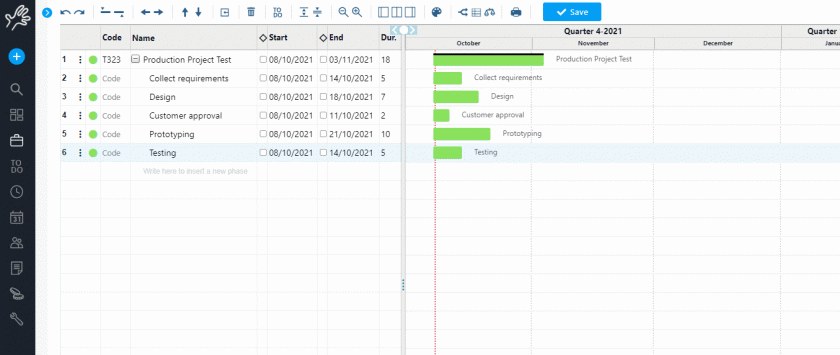
One of the best-known planning tools is the Gantt chart.
By showing activities over time, you can see their length, sequence, overlaps, and dependencies.
It’s useful beyond the initial phase.
As you update it as the project progresses, it can help you compare planned schedules with actual timelines and quickly spot tasks that are delayed.
The value of the Gantt chart increases especially in projects with numerous dependancies: a delay in a single task can affect subsequent tasks and the overall completion date.
The role of the project manager in monitoring
The project manager plays a central role in maintaining visibility into the project.
Their task is not simply to gather updates, but to interpret the information and connect it to the overall objectives.
Effective monitoring makes it possible to separate situations that require immediate action from those that can simply be kept under observation.
The project manager must also make sure that information is shared with the right people, avoiding both a lack of updates and an excess of trivial communications.
Dashboards, periodic reports, and progress meetings can be used together to create a simple and understandable monitoring system.
Don’t just check your deadlines
One of the most common mistakes is treating monitoring primarily as a way to verify deadlines.
Meeting deadlines is undoubtedly important, but it is not enough to determine a project’s success.
The scheduled deadlines may complete tasks but could use more resources than necessary, produce non-compliant results, or gradually drift away from the initial objectives.
For this reason, monitoring should include at least four elements: time, cost, quality, and results.
You may also add other factors, such as risks, resource availability, customer satisfaction, or the achievement of specific KPIs.
Quickly identify deviations
Monitoring is especially valuable as it allows you to take action before a critical issue compromises your entire project.
Project deviations can relate to timelines, budgets, available resources, or the quality of the outcome.
Identifying them quickly allows you to understand their causes and assess their potential consequences.
For example, if a key task takes longer than expected, you can determine whether:
- can be reorganized;
- additional resources may be allocated;
- some subsequent activities may be moved forward;
- it is necessary to modify the overall schedule.
This approach lets you shift from a reactive management style—where you act only after a problem has surfaced—to a more proactive one.
Twproject to maintain control over projects
To make monitoring truly effective, it is beneficial to have a tool that collects tasks, deadlines, responsibilities, and progress updates in a single platform.
Within this context, Twproject supports project management by reducing information fragmentation and providing a clearer overview of work in progress.
With Twproject, you can organize tasks and subtasks, assign responsibilities, define priorities, and monitor progress over time. This gives the project manager a clear picture of the situation and makes it easier to verify whether tasks are proceeding as planned.
Another useful monitoring tool is the Gantt chart, che permette di visualizzare la sequenza delle attività, le durate e le dipendenze. La possibilità di confrontare pianificazione e avanzamento effettivo può aiutarti a individuare ritardi e criticità prima che abbiano conseguenze rilevanti sulle successive fasi del progetto.
Twproject also makes it possible to consolidate information that, without a dedicated platform, risks being distributed across emails, spreadsheets, documents, and various tools.
Having up-to-date data in a single environment makes it easier to make informed decisions and to identify any deviations from schedules, workloads and set goals.
The benefit, therefore, is not merely knowing which tasks have been completed. Using a project management platform means being able to monitor overall progress and take specific corrective actions when necessary.
From planning to operational monitoring
One of the most common challenges stems from the gap between what is planned at the outset and what actually happens during the project execution.
Circumstances can change, some project tasks may take longer than expected, and priorities may shift. For this reason, you must continuously update the plan and compare it with the actual situation.
Twproject helps you track every phase of the work and keep planning and execution aligned. Project information is therefore not static but evolves alongside activities.
This approach can be especially useful in complex projects, where many people work simultaneously on interconnected tasks. Centralizing updates, responsibilities, and deadlines allows you to coordinate work effectively and reduces the risk of losing important information.
Track schedules, workloads and progress
To monitor a project successfully, it’s not enough to know its deadlines. You also need to understand how tasks are distributed and whether the available resources align with planned work.
A platform like Twproject helps you monitor your project from multiple perspectives, linking tasks, timelines, and the people involved.
This makes it easier to spot any overloads or slowdowns early on and take action before they have a broader impact on the project.
For every project, the goal should be to transform monitoring into a decision-making tool: not to simply accumulate data, but to use up-to-date information to understand what is happening and what actions are needed.
This continued visibility is precisely what contributes to the success of your project, because it allows you to move from management based on occasional updates to a more structured oversight of the entire process.
Project Management: from visibility to decisions
Keeping visibility means translating data and updates into useful information.
Knowing that a task is behind schedule isn’t enough: you need to understand the cause, estimate the impact on subsequent tasks, and decide how to intervene.
This ability to link monitoring and decision-making is what makes monitoring effective.
Knowing the progress of tasks, monitoring the project phases, checking resources and deadlines, and intervening quickly allows you to keep the project aligned with the set objectives.
A sound monitoring system does not guarantee that unforeseen events will not occur. What it does, however, is provide the means to recognize them sooner, understand them better, and address them with the necessary information.
This is how visibility becomes one of the most important tools for guiding a project from start to finish.
Tools like Twproject allow you to transform this visibility into a more continuous, organized, and concrete monitoring of activities.