

The skill matrix helps project managers answer a crucial question: Who has the skills needed to undertake the project’s tasks?
Assigning work based purely on availability and job title can lead to underestimating operational challenges, the need for mentoring, and reliance on specific individuals.
Understanding the team’s capabilities, on the other hand, helps you make more informed work assignments, spot missing skills, and plan for training before a problem affects deadlines. Let’s look at how to build a skills matrix and use it in day-to-day project management, linking professional skills, responsibilities, and workloads.
CONTENT
What is a skill matrix and what is it for?
A skill matrix is a table that maps employees to the skills relevant to a company or project. Typically, rows represent employees and columns represent the skills being assessed.
Where the rows and columns intersect, the employee’s skill level is displayed according to defined criteria. This makes employees’ skills easy to compare and useful for planning purposes.
This matrix can include technical knowledge, organizational skills, and interpersonal skills. For a software project, for example, it might list development, testing, requirements analysis, and client communication.
Skills matrices can be designed for a single department, a project team, or the entire company. The scope depends on the decisions you need to make: a matrix that is too broad may collect information that isn’t useful for operational assignments.
Why it improves resource allocation
Just because someone works in a technical role doesn’t mean you know which tasks they can tackle without help. The same applies to their seniority and professional credentials: they offer some insight, but don’t necessarily describe the experience required for the project.
A skills matrix allows team leaders to identify who can take on immediate responsibility, who needs support, and who could develop new skills through mentoring.
It also helps identify critical dependencies. If only one person knows how to execute a specific process, their absence can slow multiple projects at once.
This visibility supports assignments motivation, knowledge sharing, and contingency planning. The expected result is a team organized based on actual tasks, with responsibilities aligned with available skills.
How to build a skill matrix
1. Determine the required skills
The first step is to analyze activities, deliverables, and expected results. What skills are needed to complete this work? Which ones are necessary, and which ones can be developed later in the project?
Specific skills must be clearly defined: “IT skills” is too broad; “setting up a database” or “performing integration tests” provide concrete guidance.
Besides technical skills, also consider relevant soft skills: negotiation, active listening, collaboration, and problem solving. In projects involving user support, customer service can also impact the quality of the outcome.
Select only the skills that directly influence the work to be organized.
2. Define observable levels
Proficiency levels must be easily understandable to everyone. A numerical scale without descriptions leaves too much room for individual interpretation.
You can use four proficiency levels:
- Beginner: They know the principles and perform simple tasks with assistance.
- Competent: They manage recurring tasks independently.
- Proficient: They tackle complex situations and solve problems.
- Expert: They define approaches, validate results, and train others
Also include a “not evaluated” category, which is separate from “lacks competence.” This will help you avoid interpreting missing information as a negative assessment. For each level, add observable examples: completed tasks, problems solved, and proven autonomous work. This makes the evaluation more consistent and verifiable.
3. Collect and compare evaluations
Involve everyone on the team through a self-assessment, which the manager should review and compare with available evidence.
Previous projects, practical exercises, relevant certifications, and documented results help provide a reliable picture of a person’s skills.
A certification doesn’t necessarily prove operational autonomy: it’s important to verify how that knowledge is applied.
Also record how interested people are in developing a specific skill. Keep current expertise and motivation separate: interest in a task doesn’t mean someone is ready to handle it without supervision.
This comparison also makes the matrix useful for professional growth.
4. Link your skill matrix to planning with Twproject
To create a useful skill matrix, you need to link people’s skills to the tasks at hand. A skill matrix template describes who can do what, but assignments also require checking commitments and availability.
With Twproject, you can check resource workload, identify overloads, and adjust assignments based on your project’s needs. Skill information becomes the reference point for selecting who to include, while planning lets you verify who can handle the work within scheduled deadlines.
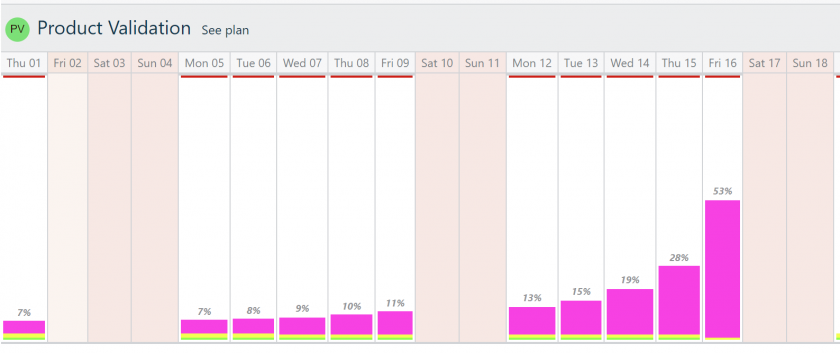
You can also schedule mentoring activities, considering the time commitments of both the person being trained and the experienced colleague. This way, skill development becomes part of daily work and helps make future assignments more sustainable.
Identify skill gaps before making assignments
A skill gap is the difference between the level required for a task and the one currently available. To determine it, compare requirements and skills instead of simply checking whether a particular skill is listed in the correct column.
For example, a project may require advanced autonomy in testing, while two team members have only hands-on experience. The skill is present, but it might not be sufficient to handle the most complex scenarios.
By identifying skill gaps, you can determine how to address them: targeted training, mentoring, external consulting, or adjusting your task allocation.
You should also separate individual skill gaps from organizational risks. A skill possessed by only one expert requires attention even when the available skill level is high.
From the matrix to project decisions
Let’s say we are planning to launch a new customer portal. This will require requirements analysis, setup, testing, and user training.
The matrix suggests that Anna is self-sufficient in analysis, Luca in setup, and Sara in training. Luca also excels in testing, but he’s already working on two demanding projects.
Assigning him both tasks could result in a bottleneck. One solution is to delegate routine testing to an operational colleague, with Luca supervising complex cases.
This decision balances expertise, availability, and risk. It also provides an opportunity to train a second team member through guided experience.
The matrix also suggests possible pairings; the planning process verifies whether these are feasible given deadlines, required effort, and other assignments.
Before confirming assignments, also determine which tasks require review and who will perform it.
An employee may be able to work autonomously but may need final validation on a particularly sensitive result. Including this step in the plan prevents support from remaining implicit and being requested only at the last minute before the deadline.
You should therefore consider the reviewer’s time alongside that of the assigned person: mentoring adds value when there is room in the schedule and shared objectives established from the start of the work.
Keep your skill matrix up to date
Update a skill matrix regularly to keep up with the team’s growth.
Schedule regular reviews and updates when new projects begin, training is completed, or new responsibilities are assumed. Completing a project is a good opportunity to collect evidence of the skills actually applied.
Link this information to training and professional development efforts: every training program should answer a specific need and provide opportunities to apply what’s learned.
When implementing a skill matrix, also clarify who can access and modify the data. Employees must understand the criteria, objectives, and procedures for reviewing evaluations.
Mistakes to avoid
One of the main mistakes to avoid is turning the matrix into a ranking list. Its purpose is to support decision-making and development by evaluating different skills and specific requirements.
Another mistake is including too many skills: this increases the maintenance workload and makes the most critical skills less visible.
Also avoid evaluations based solely on a manager’s impression or scores that aren’t comparable across departments. Lastly, don’t confuse skill with availability: a qualified person may already be working to capacity.
Assign the right resources with Twproject
Understanding your team’s skills is the first step. The skill matrix becomes valuable when it helps you assign responsibilities, prevent bottlenecks, and empower people to work more autonomously.
Twproject helps you put these decisions into practice in day-to-day project management by linking assignments, deadlines, and workloads. When priorities change, you can review your plan and reassign tasks, taking everyone’s commitments into account.
This lets the project manager make the most of available skills, anticipate needed support, and create a more balanced work structure.