

If you work in an engineering team , this situation may sound familiar to you: a resource has some spare time this week → The project manager assigns them to the delayed phase → Two days later, they discover that that phase required a skill which that person does not have → the work has to be reassigned to someone else, with the delay now doubled.
In this case, the mistake was not asking ‘who is available and has the required expertise?’ but simply selecting a resource who was available at that moment.
In this short post, we’ll look at how to use the right work planning tools to answer this question correctly.
CONTENTS
- Why this is more important in engineering than elsewhere
- The case of Repower AG
- 1. Assign tasks based on expertise, not just on the employee
- 2. Assign tasks to the team, not (just) to the individual
- 3. A different PM for each technical phase
- 4. When the same skill is required in more than one place
- A function linked to other project areas
- Would you like to see how it fits into your technical organisation chart?
Why this matters more in engineering than elsewhere
In many organisational contexts, two people in the same role are, within certain limits, interchangeable; this is not the case in engineering.
A structural engineer cannot replace an electrical engineer, a test engineer cannot stand in for a mechanical designer, and specialisation cannot be a detail to be sorted out as we go along, but is a structural constraint of the project.
When the planning of the project team overlooks this aspect and focuses solely on hourly availability, there is a risk of rescheduling resources, which in technical projects costs far more than the time lost.
Cross-checking availability against skills is not easy (we’ll see in detail why), but there are tools that simplify these processes thanks to tried-and-tested algorithms.
Below is a case study of an engineering firm that found a solution to this problem thanks to the features of a software programme.
The case of Repower AG
At Repower AG, a company operating in the energy sector and based in Switzerland, the same type of technical resources are shared across different departments: a resource may be involved in a development project and, at the same time, in a task requested by another department.
Before discovering Twproject, one of the best project management software for engineering, identifying these overlaps required a manual and time-consuming verification process, which was not very scalable as the number of people involved grew.
With Twproject, a resource’s utilisation level is calculated directly the moment it is assigned to a new task, allowing overloading to be identified before it becomes a problem.
Twproject effectively manages resource optimisation, enabling a precise distribution of the workload.

At the same time, Twproject enables you to assign skills to teams and individual staff members in a precise and timely manner, to track the development of the team’s skills and to cross-reference this data with availability and workloads.
Below, we will examine the main challenges faced by engineering firms in the allocation of resources and look at how to tackle them.
1. Assign tasks based on expertise, not just on the employee
A good project management tool allows you to categorise team members not only by organisational role, but also by skills they possess.
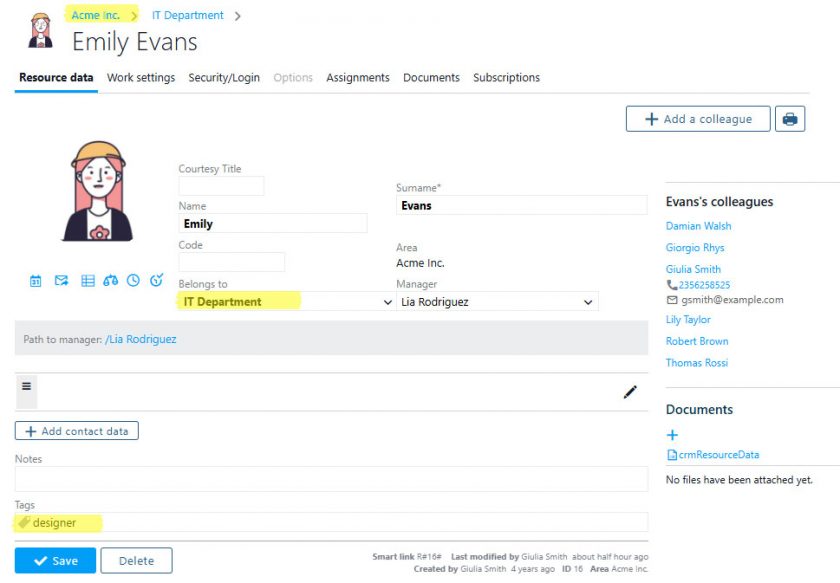
Twproject allows you to associate each resource with tags that describe their specific skills: programming languages, certifications, the type of testing they can carry out, and the tools they know how to use.
When the project manager needs to cover a technical phase, they can filter the available resources by that specific tag, rather than scrolling through a list of names and relying on their memory.
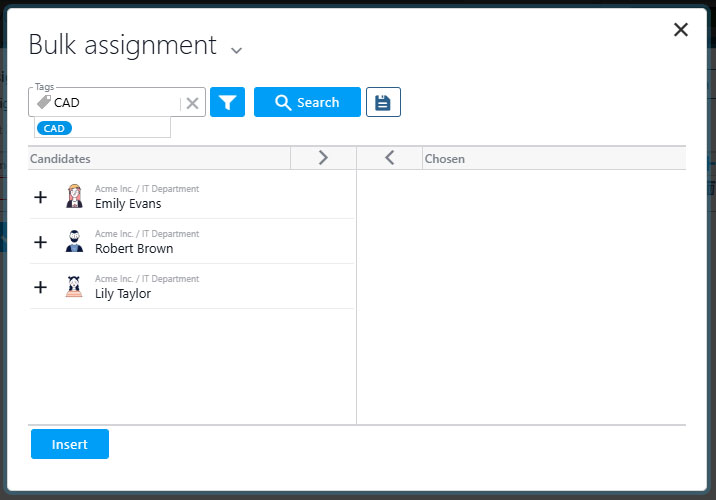
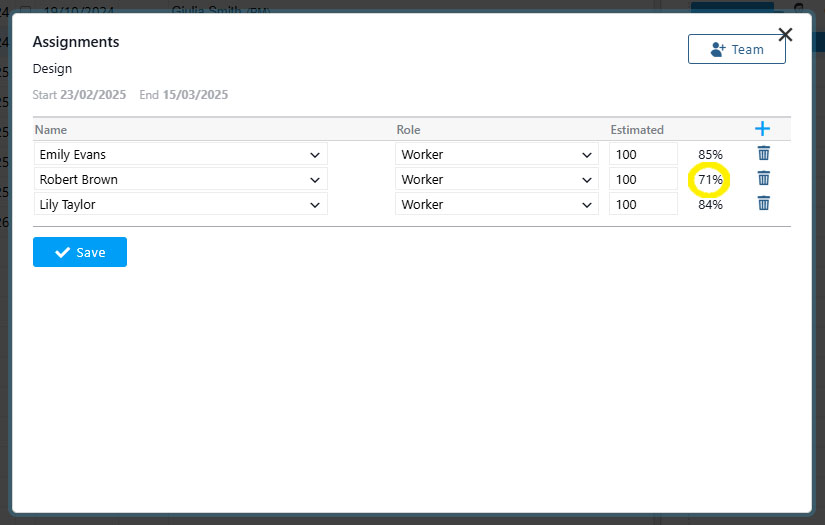
Among those resources with the required expertise, the view on workload immediately reveals who actually has spare capacity, so the final choice takes both factors into account: skills and availability.
In other words, Twproject ensures the technical feasibility of a project precisely through the allocation of resources.
2. Assign tasks to the team, not (just) to the individual
There is another useful option when a phase is technically complex and involves several people: assign it to an entire team or department, rather than to a single person.
In this way, the overall project manager immediately checks the group’s combined availability, which is sufficient to assess the feasibility of the phase; they then leave the task allocation to the head of that team, who knows the internal skills better than anyone else.
Operational decision-making is delegated to those with the most accurate information, without the overall project manager losing overview of the project.
3. A different PM for each technical phase
In multidisciplinary engineering projects, overall coordination and detailed technical expertise are often not held by the same person.
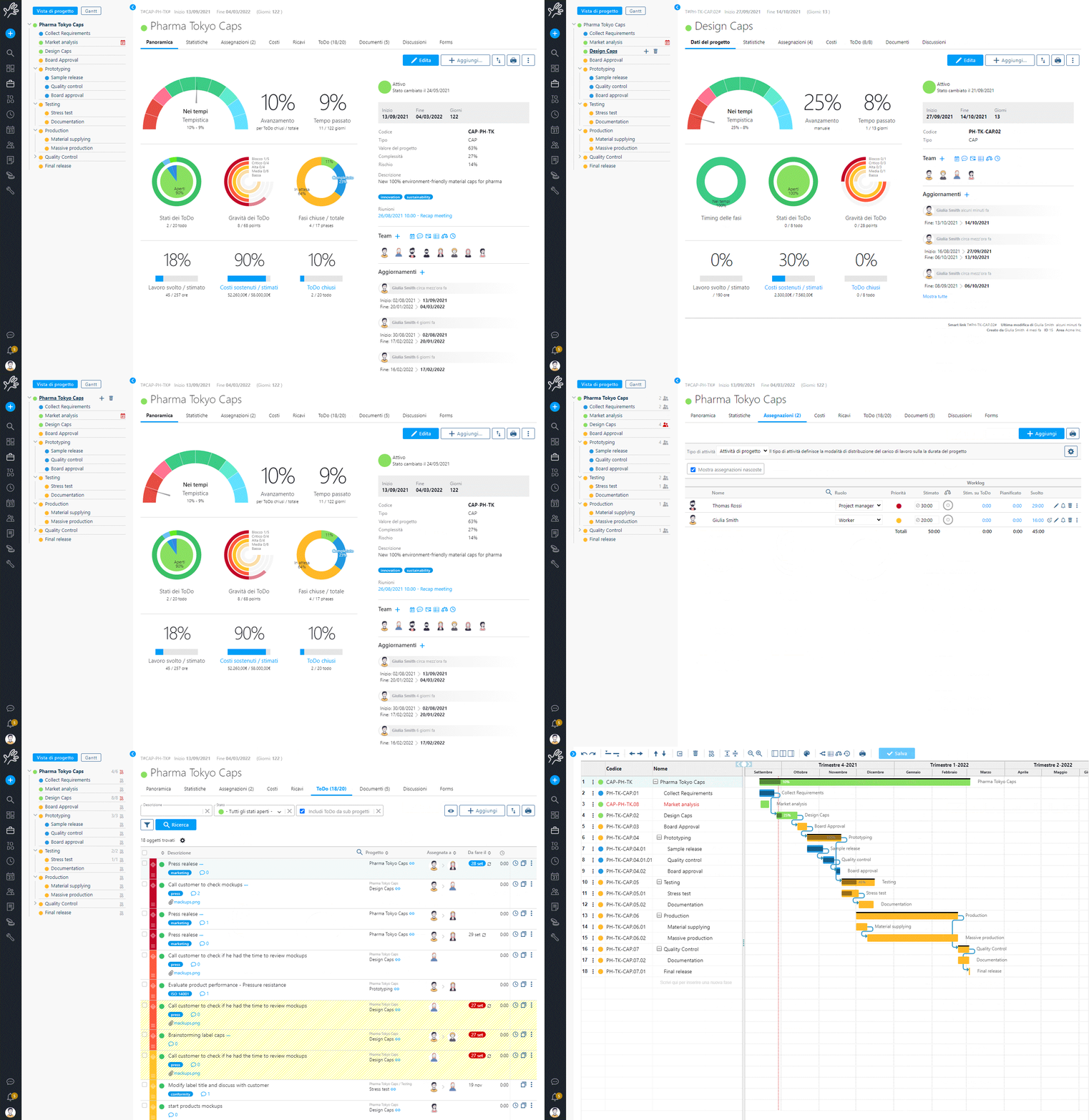
For this reason, in the WBS of Twproject, which is highly flexible and customisable, the sub-phases of a project can have a project manager different from that of the main project.
In this way, the overall PM maintains the big picture, the overall deadlines and the review processes; at the same time, a highly specialised phase, such as electrical testing or structural validation, has a manager who is responsible for the technical aspects, without having to run every decision through central coordination.
The result is a chain of responsibility that truly reflects how an engineering department works, rather than a simplified diagram that bears no relation to reality.
4. When the same skill is needed in more than one place
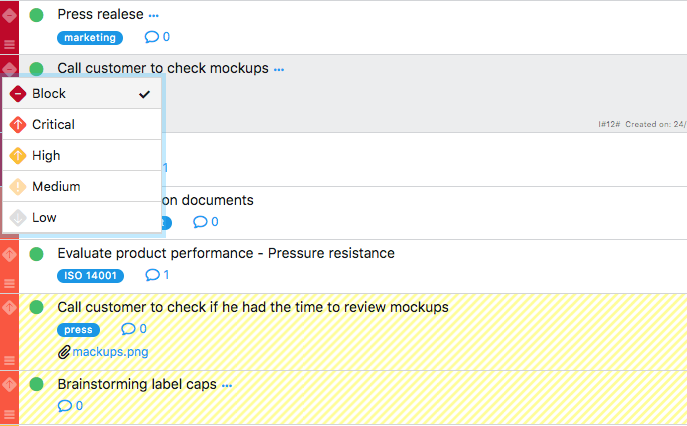
Once you have found the resources with the right skills, you need to set the priorities. In fact, sometimes the staff have the necessary skills, but they are required by several projects at the same time.
In such cases, setting priorities directly within the assignments allows the resource to know what to focus on first, and enables the project manager to adjust the sequence of activities without having to call a meeting every time priorities change.
Incidentally, this same prioritisation mechanism is what simplifies the more operational side of things, namely the management of technical tickets: knowing who should deal with what first, rather than just who is generally responsible for it.
A function linked to other project areas
The accrual-based allocation does not stand alone. The workload assigned to a resource, whatever the criteria used to select it, is reflected in their weekly schedule, where it can be adjusted on a day-to-day basis (we discussed this in relation to the My Weekly Workspace).
And the very same skills required today to assign a phase are those that, even before the project gets underway, must be assessed to determine its technical feasibility, an issue linked to risk analysis.
The entire engineering department, after all, relies on this kind of continuity between processes, which Twproject unifies and simplifies.
To see a brief overview of how resource management works in Twproject, watch:
And more specifically, here’s how to occupy your team most effectively:
Would you like to see how it fits into your technical organisation chart?
When you book a free demo, Twproject provides a dedicated tutor, an expert in technical and engineering departments, who works alongside your team to set up skills, shared workgroups and assignment priorities, showing you exactly how to configure roles and projects within your specific context.
👉 Book here and get a free tutorial