
Dependencies between tasks are the invisible thread that ties every project plan together: when they aren’t mapped correctly, a delay in a single task can bring the rest of the work to a halt.
For project managers in the manufacturing industry, where a stalled production line literally eats up money every minute, this problem isn’t just theoretical, it’s one of the most common causes of schedule and cost creep.
In this article, we’ll discuss the different types of dependencies a project manager needs to identify, how to map them systematically, and, most importantly, how to prevent bottlenecks before they turn into production stoppages or delivery delays.
TABLE OF CONTENT
- Why dependencies between tasks are a risk that must be actively managed
- Dependency types: the classification every project manager needs to know
- The four logical sequence relations
- The nature of the constraint
- How to map dependencies between tasks: the four-step method
- A Real-Life example from the manufacturing industry
- Preventing halts: operational strategies
- Troubleshooting when the halt still occurs
- Dependencies between tasks: the role of Twproject
Why dependencies between tasks are a risk that must be actively managed
Any project, no matter how well planned, involves a series of tasks that impact each other. Poor management of these dependencies can trigger a chain reaction that is difficult to recover from: if Task B cannot begin until Task A is completed, a delay in Task A automatically affects Task B, all subsequent tasks, and—in the worst case—the entire critical path of the project.
In the manufacturing industry, for example, this risk is magnified by some specific factors:
● Production lines are often sequential, so a bottleneck at one stage immediately affects the subsequent stages;
● Procurement times for materials create external dependencies that are difficult to control directly;
● Shift changes and scheduled machine maintenance lead to tight schedules that other tasks have to stick to;
● Line downtime, calculated in hours or even minutes, makes each event much more costly than in other industries.
That’s why mapping the dependencies between activities isn’t just an academic exercise to be done once at the start of the project, but an ongoing monitoring activity that must continue throughout the entire project lifecycle.
Dependency types: the classification every project manager needs to know
Before mapping dependencies, you need to identify the types of dependencies that can link two or more tasks. Dependencies can be classified according to two main criteria: sequence logic and the nature of the constraint.
The four logical sequence relations
● Finish-to-Start: The next task can begin only after the previous one has been completed. This is the most common type, for example, when testing a machine after assembly.
● Start-to-Start: Two tasks can begin simultaneously or close to one another, such as graphic design and copywriting for a campaign.
● Finish-to-Finish: Two tasks must be completed at the same time, which is typical in the simultaneous production run of multiple interconnected lines.
● Start-to-Finish: This is a rare relationship in which the start of one task leads to the end of another, as happens with work shifts.
The nature of the constraint
Besides the logical sequence, the different types of dependencies also differ based on their nature:
● Hard logic: Dictated by the very nature of the work; they are non-negotiable. You cannot paint a part before it has been processed.
● Soft logic: Organizational decisions made by the team, often based on best practices, which can be adjusted if necessary.
● External dependencies: Related to aspects beyond the project’s direct control, such as the delivery of raw materials by a supplier or regulatory approval.
● Internal dependencies: Tasks managed by the same team or the same company, which are therefore easier to renegotiate in case of critical issues.
Identifying which category each dependency belongs to can be critical in understanding how much flexibility you actually have when a risk of a block emerges: an external dependency requires a different contingency plan than a discretionary dependency, which can simply be reorganized.
How to map dependencies between tasks: the four-step method
1. Build a detailed WBS
Mapping always starts with a https://twproject.com/blog/break-project-examples-wbs/ into basic tasks. The more accurately the tasks are defined, the easier it will be to pinpoint the true relationships between them, and avoid overly general dependencies that mask specific constraints.
2. Building a Dependency Matrix
For each task, you should indicate which other tasks it depends on and which ones are dependent on it, specifying the type of relationship (End-to-Start, Start-to-Start, etc.) and the nature of the constraint (mandatory, discretionary, external, internal). This tool (even if it’s just a simple spreadsheet) provides a clear overview of the dependency chains that would otherwise only exist implicitly in the project manager’s thoughts.
3. Visualize with Gantt and PERT
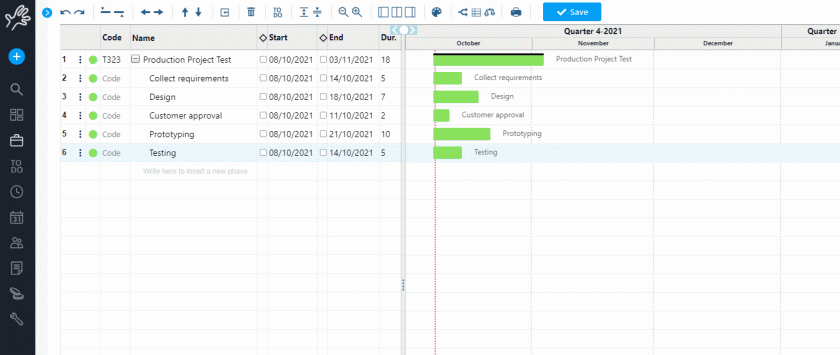
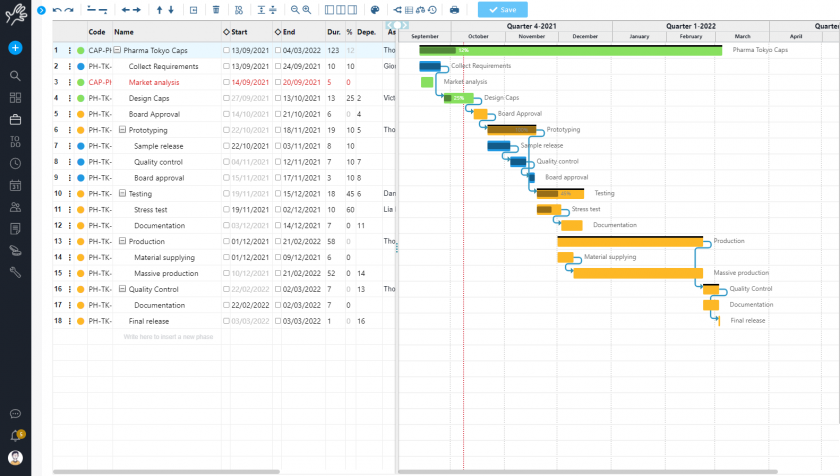
Once mapped, dependencies should be presented visually. The Gantt chart shows the timeline and relationships between task bars, while a network diagram such as PERT more clearly highlights the critical path and the nodes where a delay could be most detrimental to the entire project.
4. Identify potential chokepoints
Once the complete map is complete, you can identify the so-called “bottlenecks” – activities on which many other downstream activities depend. In the manufacturing industry, these points often involve testing phases, quality control, or handoffs between departments, where a stoppage affects the entire production line.
A Real-Life example from the manufacturing industry
Let’s consider an assembly line that manufactures electromechanical components. The final testing phase depends on the completion of assembly (mandatory end-to-start dependency), but it also requires assistance from a qualified technician, who is assigned to another line during that shift (discretionary resource-based dependency).
If assembly experiences a minor delay of thirty minutes, but the technician is still busy elsewhere for an hour, the real bottleneck isn’t assembly—it’s the availability of the resource.
Without a clear dependency map, the project manager would risk focusing recovery efforts on the wrong area, wasting valuable time while the line remains idle. This type of analysis—simple on paper but often overlooked in daily practice—is exactly what systematic dependency mapping helps prevent.
Preventing halts: operational strategies
Mapping dependencies is only the first step: The real added value lies in translating this map into tangible preventive actions. Here are some examples:
● Add strategic buffers. For critical dependencies—especially external ones, such as deliveries from a supplier—it’s helpful to build in time buffers that can cushion minor delays without causing them to snowball downstream.
● Monitor the critical path in real time. A delay in a task that is not on the critical path can be handled with more ease; a delay in a critical task, on the other hand, requires immediate action. Good project management software like Twproject automatically alerts you when a task is at risk of becoming critical.
● Set up automatic alerts for critical dependencies. Automatic notifications, triggered when preceding tasks are completed, allow the project manager to take action before a bottleneck occurs, rather than finding out about it when it’s already too late.
● Periodically review the dependency map. In manufacturing projects, where operating conditions change frequently (suppliers, machine availability, workforce), the original dependency map should be updated at regular intervals, not just at the start of the project.
● Define contingency plans for external dependencies. Alternative suppliers, emergency procedures, or parallel production paths reduce the impact of a bottleneck that does not directly depend on the project team.
Troubleshooting when the halt still occurs
Even with the best possible planning, a bottleneck can still happen. In these cases, problem-solving becomes a key skill for the project manager, just as much as planning itself. The recommended steps are:
1. Isolate the bottlenecked activity and check whether the bottleneck is actually due to the mapped dependency or whether it masks a different cause (lack of resources, estimation error, technical issue).
2. Consider your options: Can you start other non-dependent tasks in parallel, making up time elsewhere while resolving the critical bottleneck?
3. Promptly communicate the impact of the bottleneck to all stakeholders involved, ensuring that news does not reach them too late and reduce the time available to act.
4. Update your planning once the bottleneck is resolved, assessing the ripple effect on subsequent tasks and recalculating your new critical path.
Dependencies between tasks: the role of Twproject
Manually managing dependencies between tasks quickly becomes unsustainable beyond a certain project size. Software with an interactive Gantt chart, such as Twproject, allows you to:
● automatically view all dependencies and the critical path;
● receive alerts when a delay risks spreading;
● automatically recalculate the dates of downstream tasks when an upstream deadline changes;
● compare planned versus actual progress to act before a delay becomes serious.
For teams working in manufacturing, where every hour of line downtime comes at a direct and measurable cost, this real-time visibility often makes the difference between a minor delay that can be absorbed without consequences and a production shutdown that affects the entire supply chain.
The dependencies between tasks are not a technical detail to be addressed only once during the planning phase, but a dynamic element that must be monitored throughout the entire project.
Understanding the different types of dependencies, mapping them systematically, and developing contingency plans for the most critical ones allows you to drastically reduce the risk of bottlenecks—especially in settings such as manufacturing, where the cost of a shutdown is measured in hours and money.
Investing time in mapping today means saving time and avoiding the stress of emergency management in the following weeks. Project leaders, in manufacturing as in other industries, should treat the dependency map as a living document—one to be revised whenever operating conditions change—rather than as an attachment to be filed away after the project kick-off.