
Annual planning is one of the most critical and strategic moments for project managers.
Looking toward the next 12 months means turning often abstract business objectives into tangible activities, allocating resources correctly, and preventing critical issues before they arise. Without a structured vision, there is a risk of proceeding on an emergency basis, losing control over time, costs, and priorities.
An effective organization does not mean making work more inflexible; rather, it means creating a clear framework that allows you to adapt to change while maintaining direction.
CONTENT
Why annual planning is crucial
A sound annual plan allows you to align strategy and operations. When projects are planned annually, it becomes easier to understand how individual efforts contribute to achieving business goals. This approach minimizes overlap, improves collaboration between teams, and promotes a more balanced distribution of workloads.
Planning does not eliminate uncertainty, but it can be a powerful tool for managing it. Having a clear roadmap enables you to make faster, more informed decisions when priorities change or new opportunities arise.
From strategy to operational plan
The first step in annual planning is to transpose the corporate strategy into planning efforts. This means identifying which projects to initiate, which to continue, and which to potentially suspend. The annual plan may seem like a long way off, but it is precisely this extended vision that helps to avoid unsustainable short-term choices.
Having defined your projects, you need to break them down into phases, milestones, and tasks. This is where the project manager’s skill in balancing detail and overall perspective comes into play. A plan that is too broad risks being useless, while one that is overly detailed becomes difficult to keep up to date for the entire 12 months.
Planning tools
Relying on spreadsheets or static documents makes managing annual plans challenging.
Planning tools are not only used to build a project calendar but also serve as a starting point for managing the entire annual planning cycle.
Dedicated management software such as Twproject helps centralize information, link projects together, and monitor progress over time.
It also provides a visual representation of the plan through Gantt charts, helping to understand dependencies, overlaps, and workloads.
This visual representation can help project managers identify bottlenecks and take action before they become real problems.
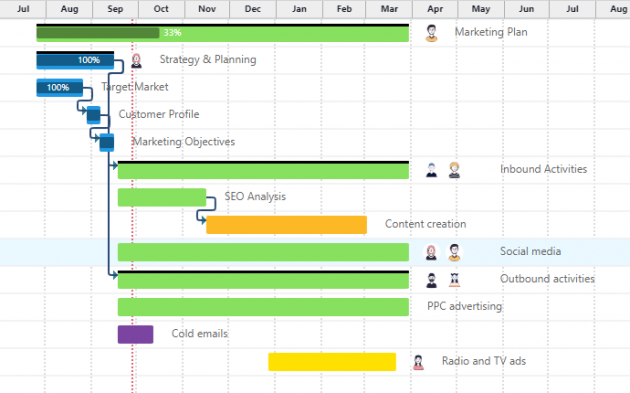
This visual representation can help project managers identify bottlenecks and take action before they become real problems.
Planning resources and production capacity
After defining the overall framework of the projects, the first area affected by the tools is resource planning. Planning means estimating teams’ production capacity up front and verifying that it aligns with the number of projects planned.
Without this step, even the best plan is at risk of failure.
An annual overview helps you spot periods of overload or underutilization, making it simpler to decide whether to add new resources, redefine priorities, or push back on certain activities. Realistic resource planning is often what separates a theoretical plan from one that can actually be put into action.
Continued monitoring and review
Resource planning, however, is insufficient without constant monitoring.
A common mistake is treating the annual plan as a static document. As a matter of fact, annual planning only works if it is monitored and updated over time. Projects evolve, market conditions change, and new needs may emerge.
A successful approach involves periodic reviews, either monthly or quarterly, to check that planning is aligned with operational reality. This does not involve replanning everything but rather adapting what is necessary while maintaining focus on achieving objectives.
Managing priorities across multiple projects
Ongoing monitoring also provides the information needed to manage priorities.
One of the most common problems for project managers is competition between multiple projects throughout the year. Annual planning allows clear priorities to be established from the outset, reducing conflicts and constant changes of direction.
When priorities are shared and clear, it’s easier to explain why a task has to wait or why one project has priority over another. This approach improves collaboration between teams and strengthens the project manager’s role as a facilitator, not just a controller.
Align stakeholders and business management
Annual planning is also a powerful communication tool for stakeholders and management. Presenting a clear picture of planned projects, timelines, and resources involved makes it easier to discuss things and reduce misunderstandings.
For project managers, this means working with more realistic expectations and getting more support for critical decisions. A shared plan builds trust and makes it easier to justify changes that arise during the project.
Measuring results and performance over time
Annual planning becomes truly useful when it provides a concrete way to measure project progress.
Defining clear objectives and milestones over 12 months gives project managers the flexibility to compare what was planned with what was actually achieved, identifying any deviations in timing, workload, and progress.
Indicators such as meeting deadlines, resource utilization, and task completion help to understand whether a project is moving in the right direction or if corrective measures are needed.
This type of metric makes it clear whether the work being done contributes to achieving strategic objectives or absorbs resources without generating value.
With Twproject’s support, data is collected seamlessly and made comparable over time, transforming annual planning into a practical decision-making tool.
This way, project managers can act promptly, review priorities, and maintain control even in a constantly changing environment.