

Creating a work plan for your department involves more than just scheduling tasks and setting deadlines. It means providing clear direction for daily work, ensuring that everyone is aligned with company goals, and converting business strategies into concrete actions.
Knowing how to create a work plan is now a key skill for department heads, team leaders, and managers who want to improve results, efficiency, and collaboration.
In this article, we will explore how to structure a work project, avoiding common mistakes and using standard project management methods and tools, adapting them to your department’s specific needs.
CONTENT
- Why create a work project for your department
- Defining the objective: the starting point
- Identifying the scope and boundaries of a project
- Bringing in the right people
- Breaking down work into concrete tasks
- Planning schedules and deadlines
- Assigning resources and responsibilities
- Managing risks and unexpected occurrences
- Monitoring project progress
- Communicating with stakeholders
- Choosing the right management tool
Why create a work project for your department
A department often handles repetitive or operational tasks, but that does not mean it lacks logic behind its planning. Quite the contrary: when structure and vision are lacking, there is a risk of working hard without achieving any real end result.
Creating a work plan serves to:
- clarify priorities;
- coordinate team members;
- properly allocate resources and time;
- measure results objectively.
A well-defined project makes work more predictable, reduces inefficiencies, and improves communication within and outside the department, especially with stakeholders.
Defining the objective: the starting point
All projects begin from a need. Before discussing activities, tools, or deadlines, it is essential to pause and understand what you want to achieve.
Your goal:
- must be clear and understandable;
- must be shared with your team;
- must have a measurable impact on your department or organization.
A common mistake is to start directly from the task list. Realistically, without a defined goal, each task risks being disconnected from the value it should generate.
Ask yourself:
How will we know if our project will be successful?
What problem are we trying to solve?
What tangible change do we want to achieve?
Identifying the scope and boundaries of a project
After clarifying the objective, define the project scope. This step is often underestimated, but it is crucial to avoid misunderstandings and work overload.
The scope clarifies:
- what is included in your project;
- what is not included;
- what results are expected from your department.
Without clear boundaries, your project will need constant fine-tuning and might get out of hand. Defining the scope also helps stakeholders understand what to expect and what not to expect.
Bringing in the right people
A departmental project is never a solo effort. Even when the scope is limited, it requires skills, information, and collaboration.
Identify from the outset:
- the team members involved;
- roles and responsibilities;
- any external figures who may be impacted by the project.
The role of the project manager (even if unofficial) is to coordinate people, facilitate communication, and maintain focus on goals. In a department, this role is often filled by the manager or a project lead.
Breaking down work into concrete tasks
Now that you’ve got your goals, scope, and people sorted, it’s time to get into the nitty-gritty of planning. This is where one of the basic principles of project management comes into play: breaking work down.
Every project should be split into smaller, more manageable, and measurable tasks. To create an effective project plan:
- list all the activities necessary to get the job done;
- define a logical sequence;
- identify dependencies between activities.
This step is key to estimating realistic workloads for your department and avoiding important parts being overlooked.
Planning schedules and deadlines
Once tasks have been defined, it is time to schedule them. Scheduling helps you view the entire project and assess whether deadlines are realistic.
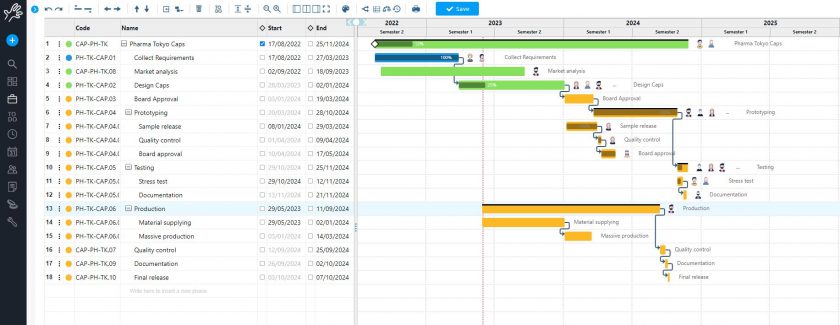
The Gantt chart is one of the most popular tools for this purpose. It helps you:
- see how long each task takes;
- see dependencies;
- track progress.
Even for a department, using a Gantt chart makes work more transparent and easier to coordinate, especially when multiple people are working in parallel.
Assigning resources and responsibilities
A project does not rely solely on time, but also on resources. When creating a work project, you need to clarify:
- who does what;
- with what skills;
- in how much time.
Resources include not only people, but also tools, budgets, information, and organizational support. Successful project management depends on balancing workloads with actual availability. Assigning clear responsibilities increases ownership and reduces the risk of overlapping or operational gaps.
Managing risks and unexpected occurrences
No project is immune to uncertainty. Even within a department, ignoring risks exposes you to avoidable delays and problems.
Risk management consists of identifying beforehand:
- what could go wrong;
- how likely it is to happen;
- what impact it would have on your project.
There’s no need to come up with elaborate analyses: often, a shared list of risks and preventive actions is enough. This approach makes your team more responsive and reduces unpleasant surprises during execution.
Monitoring project progress
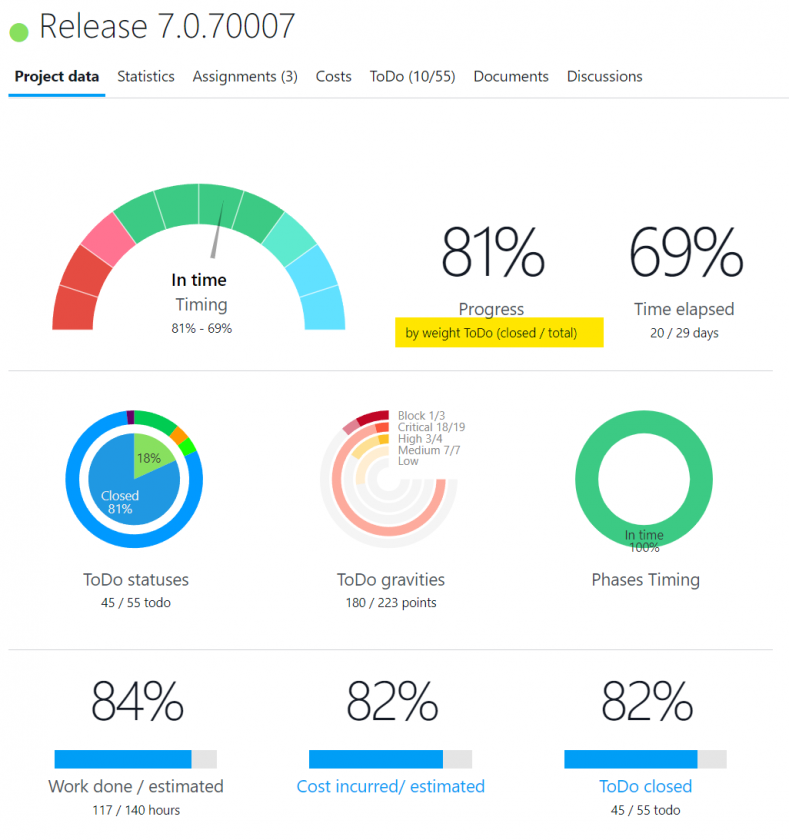
A project is not something you simply “launch” and then forget about. Monitoring is a core part of project management.
During execution, it is important to:
- check activity status;
- compare planned and actual results;
- take action in case of deviations.
Regularly updating project plans helps keep teams and stakeholders aligned and allows decisions to be made based on concrete data, not gut feelings.
Communicating with stakeholders
Communication is often the key to success. Stakeholders must be kept up to date in a consistent manner, proportionate to their role.
Good project communication:
- clarifies expectations and priorities;
- reduces misunderstandings;
- builds trust in your department’s efforts.
You don’t need to share everything with everyone, but it’s essential to determine who needs to know what, when, and at what level of detail.
Choosing the right management tool
To make your day-to-day management sustainable, it is useful to adopt a management tool that supports planning, collaboration, and monitoring.
Project management software such as Twproject helps you:
- centralize information and documents;
- view activities and deadlines;
- collaborate in real time;
- track progress.
Wrapping up your project and evaluating the results
The closing step is often overlooked, but it is the one that allows you to learn. Closing a project means checking whether the goal has been achieved and evaluating the final result.
Ask yourself:
- What went well?
- What could have been done better?
- Which practices should be replicated in future projects?
This analysis makes each project an opportunity for growth for both your department and company.
Creating a work project for your department is not a purely theoretical task; it is a concrete way to improve organization, results, and collaboration. By applying project management principles to internal initiatives, you can work with greater clarity and control.
With defined objectives, a clear scope, an engaged team, and the right tools, your project becomes a daily guiding light rather than a bureaucratic burden. And that is precisely the difference between working hard and working effectively.