

Gantt vs Roadmap? This comparison is particularly relevant in multi-project settings, where the same resources are involved in multiple efforts and workload management is a critical factor.
What are the actual differences? When is it better to use a Gantt chart, and when is it better to use a roadmap? And, most importantly, how can they be best utilized within project management software?
In this article, we will examine the differences and advantages, with a practical focus on how Gantt becomes a must-have tool for those who manage complex projects.
CONTENT
What is a Gantt chart?
The Gantt chart is the backbone of planning. It is a bar chart that provides a detailed schedule of all the tasks required to complete a project.
Unlike the roadmap, Gantt charts are more practical: they define task dependencies, assign resources, and set a precise project timeline. If the roadmap is the strategy, Gantt charts are the execution.
What is a project roadmap?
The project roadmap is a high-level visual depiction of the objectives and strategic direction of an endeavor. It is the ultimate tool for communicating a vision to stakeholders and cross-functional teams without swamping them with technical details.
Product roadmaps, for example, do not list every single activity, but focus on high-level plans and how the project will evolve over time to achieve business objectives. It is the document that answers the question: “Where are we headed?”.
Gantt vs Roadmap: differences, pros, and use cases
In the Gantt vs. Roadmap discussion, the point isn’t to pick the “best” tool, but to understand what decision you want to support at a given moment in the project lifecycle.
Roadmaps and Gantt charts answer different questions:
- roadmaps clarify where we are headed
- Gantt charts dictate how, when, and with what constraints we get there
Mixing them up leads to two common mistakes: roadmaps that are too operational or Gantt charts used as simple presentation slides.
To choose between a roadmap and a Gantt chart, it is necessary to consider three factors:
- The objective: The roadmap provides the overall picture; the Gantt chart is used for operational project planning.
- The audience: the roadmap is meant for executives and clients; the Gantt chart is the everyday tool for team members and project managers.
- The details: the roadmap shows the project’s milestones; the Gantt chart shows every task, sub-task, and time constraint.
The difference between Gantt charts and roadmaps becomes clear when you consider how they are used in projects.
Roadmaps are helpful when prioritizing decisions, aligning stakeholders, or providing a common direction for teams that are not yet operating at the same operational level.
It is the perfect tool for sharing an overview, discussing alternative scenarios, or communicating what will be done and in what order, without delving into the details of daily activities.
The Gantt chart, on the other hand, becomes vital when the project needs to be executed. When real dependencies between activities, shared resources, and time constraints come into play, the roadmap is no longer sufficient.
Gantt charts help you build a believable plan, assess the impact of each change, and track progress. In complex situations, with multiple active projects and distributed teams, Gantt charts aren’t just for “representing” the project, but for managing it over time.
The true role of Gantt charts in operational management
A Gantt chart is not a “detailed” view, but a tool for managing the project process.
A well-planned Gantt chart makes it possible to:
- create a detailed and coherent schedule
- manage dependencies between tasks
- maintain a credible project timeline
- verify the impact of any changes on schedules and workloads
- manage projects predictively
From a practical viewpoint, the Gantt chart is a project management tool that becomes truly indispensable when it is:
- up to date
- linked to resources
- dynamic, not static
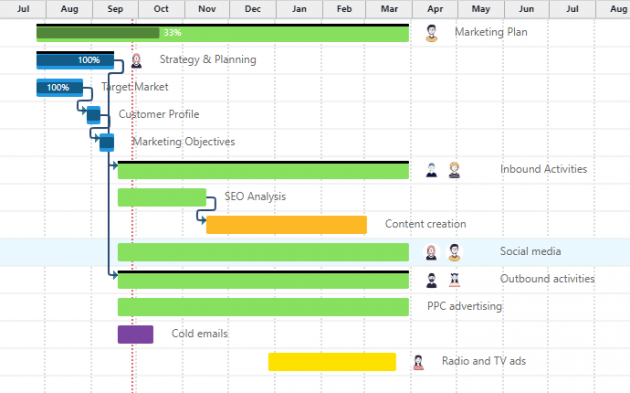
In Twproject, the Gantt chart updates in real time: moving a task, changing a duration, or changing a dependency immediately updates the entire plan, making it possible to monitor progress without rebuilding everything every week.
Roadmap: a decision-making tool
The roadmap is more of a strategic, condensed take on the project.
It doesn’t get into the ins and outs of each task, but gives you a big pictureof the goals, main steps, and direction of the work.
It’s particularly helpful when you need to get stakeholders and cross-functional teams on the same page, share priorities, and give everyone a sense of the project as a whole, without getting into the nitty-gritty planning needed for day-to-day management.
The value of the project roadmap is in its power to:
- simplify complexities
- show priorities and logical sequences
- communicate without going into detail about activities
For this reason, it is not an operational planning tool: It does not manage dependencies, show workloads, or dictate real constraints.
Pros of an integrated approach
Using full-featured project management software such as Twproject means not having to choose between the two, but allowing them to coexist.
When to use a Roadmap:
- To align stakeholders on long-term objectives.
- To present product development in a simple way.
- To prioritize macro areas of intervention.
When to use Gantt:
Twproject’s Gantt is designed for those who need to monitor progress with pinpoint accuracy. With this planning tool, you can:
- See the impact of a delay on subsequent activities at a glance.
- Manage complex workloads and overlapping deadlines.
- Update your plan in real time to reflect operational changes.
Truth is, you need both for truly excellent management. The roadmap sets the course, but it’s the Gantt chart that lets you navigate around obstacles.
If you’re looking for a tool that focuses on Gantt charts to transform your strategy into an impeccable action plan, Twproject is the perfect solution. With its user-friendly interface and ability to manage complex dependencies, you’ll always have complete control over your project timeline, ensuring that every team member knows exactly what to do and when.
Organising a major event (e.g., international trade fair)
When organizing a major event, such as an international trade fair, the distinction between Gantt charts and roadmaps becomes particularly clear, as projects go through distinct phases with radically different requirements.
In the early stages, roadmaps are the most effective tool for stakeholder engagement: they are used to set the event’s theme, outline its general setup, determine the overall budget, and choose the location.
This is when partners and sponsors come together around a common vision, working on broad timeframes and strategic decisions, without getting into operational details.
As the event date approaches, however, the complexity grows rapidly, and the roadmap is no longer sufficient. In the final weeks, all activities are time-bound and interdependent: booth assembly, audio and video testing, space setup, guest reception, and logistics management must be coordinated down to the minute.
At this stage, the Gantt chart becomes the core tool for the operational team, enabling them to manage dependencies, sequences, and workloads realistically.
A project management tool that seamlessly integrates roadmaps and Gantt charts allows you to turn strategic decisions into an executable plan.
Twproject’s Gantt specifically allows you to identify bottlenecks and overloads before they turn into emergencies, maintaining control over a project with a non-negotiable deadline.
Ultimately, the challenge does not really boil down to Gantt vs. Roadmap, but rather how to make them work together to prevent strategy from remaining just a dream and operations from descending into chaos.
A project roadmap without a Gantt chart risks being an empty promise; a Gantt chart without a roadmap risks becoming an endless list of tasks without a clear purpose.
To manage projects successfully, flexibility is key. You need a project management tool like Twproject that allows managers to maintain an overview while enabling team members to follow a detailed plan with no margin for error.
