

Multi-project planning is essential for companies that manage multiple projects simultaneously and need to ensure seamless operations, high-quality results, and cost control.
In an increasingly dynamic landscape where resources are often shared, balancing activities, priorities, and availability becomes a true challenge in project management.
It is not just a matter of replicating classic planning several times, but of building an integrated strategy in which each project interacts with the others, preventing conflicts and overloads.
CONTENT
- Why is multi-project planning so important?
- 1. Understanding the complexity of multi-project management
- 2. Defining clear priorities between each project
- 3. Planning resources realistically
- 4. Coordinating efforts across different projects
- 5. Constant progress monitoring
- 6. Organizing effective and brief meetings
- 7. Creating shared processes and standards
- 8. Using integrated software for multi-project control
- 9. Fostering a culture of collaboration
Tools such as Twproject help get a thorough and realistic view of the work, but it is also essential to adopt a methodical approach.
In this article, we will explore how to coordinate teams and resources effectively when working on multiple projects at once.
Why is multi-project planning so important?
Coordinating multiple efforts simultaneously requires a cross-functional approach and the skill to allocate limited resources to different objectives.
Without a structured approach, the risk is creating bottlenecks, overloads, and delays in the chain. This is why planning is not just a technical exercise, but a strategic element for business.
1. Understanding the complexity of multi-project management
Multi-project management means that the same team, or part of it, gets involved in multiple undertakings. This brings with it some typical risks:
- overlapping activities;
- workload peaks that are hard to sustain;
- conflicting priorities;
- slowdowns due to dependencies between projects;
- lack of visibility on the actual status of resources.
The project manager must therefore become an orchestra conductor, managing both the vertical needs of individual projects and the cross-sectional vision of the entire portfolio.
Poor planning inevitably leads to delays, additional costs, and loss of quality. This is why project planning must be structured, continuous, and dynamic.
2. Defining clear priorities between each project
The foundation of multi-project planning is prioritization. All organizations should establish clear criteria such as:
- business value;
- risk;
- customer impact;
- binding deadlines;
- technological or operational dependencies.
The project manager must be able to communicate these priorities to their team, avoiding situations in which everyone works on the “noisiest project,” that is, the one that seems most urgent at the moment but may not be the most important.
Twproject, for example, allows you to easily visualize each project’s priority level and its impact on the team’s work, facilitating transparent, shared decision-making.o impatto sul lavoro dei team, facilitando decisioni trasparenti e condivise.
3. Planning resources realistically
A major challenge is allocating resources correctly. It is not enough to simply assign tasks; it is necessary to consider:
- actual availability (schedules, vacations, allocable hours);
- specific skills;
- work progress;
- potential conflicts between projects.
Multi-project planning should therefore be based on up-to-date and measurable data. Sometimes it is not possible to assemble an ideal team: the project manager must allocate the right people at the right times.
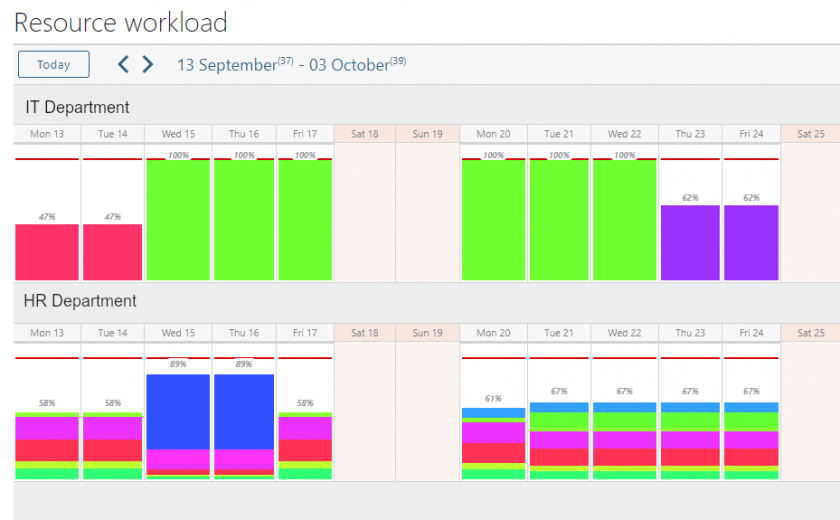
In this regard, tools with advanced planning features are very helpful: Twproject, for example, instantly shows each team member’s workload, highlighting overloads or remaining availability. This allows you to balance activities in real time.
4. Coordinating efforts across different projects
When managing multiple projects simultaneously, it is easy to underestimate interdependencies. To coordinate activities correctly, it is helpful to:
- draw a map of the dependencies between each project;
- separate critical activities from those that can be postponed;
- maintain an integrated calendar;
- ensure cross-functional teams share regular updates.
This way, project planning becomes streamlined and consistent. It is not just about taking action when a problem arises, but about getting ahead of potential issues.
5. Constant progress monitoring
In a multi-project environment, monitoring is as important as planning.
The project manager should:
- check the actual status of each activity;
- verify that deadlines are being met;
- assess workload variability;
- update the plan based on changes or new requests.
This process must be nonstop: multi-project planning isn’t static; it evolves day by day. Dashboards, alerts, and automated reports let you keep the situation under control and make quick decisions.
6. Organizing effective and brief meetings
For multi-project management to work, effective communication is crucial.
Yet too many meetings can risk interrupting work and slowing overall progress. It is therefore advisable to keep synchronizations short, daily or biweekly, organize multi-team meetings only when necessary to resolve priority conflicts, share goals and milestones clearly, and use collaborative tools that prevent misunderstandings.
Streamlined, focused communication reduces the risk that each project will take a different direction, creating misalignments that are difficult to recover from.
7. Creating shared processes and standards
When a company manages multiple projects, using different methodologies for each can be risky. Instead, it is recommended to:
- adopt shared templates;
- standardize deliverables and approval flows;
- define consistent evaluation criteria;
- use a single tracking system.
This gives the project manager more control over the situation, more quickly and consistently.
Again, Twproject is a valuable ally: it helps create customizable, repeatable workflows, ensuring everything stays consistent across all projects.
8. Using integrated software for multi-project control
Modern work is so complex that it’s now indispensable to use tools designed for real project portfolio management. Good software should offer:
- a holistic view of all projects;
- centralized workload management;
- dynamic resource planning;
- constant progress monitoring;
- analytics and reporting;
- integrated collaboration.
Twproject was created to address these dynamics: it combines operational flexibility with a solid, straightforward system, ideal for companies working on multiple undertakings simultaneously.
9. Fostering a culture of collaboration
In multi-project management, technology alone is not enough: a supportive environment is needed to foster genuine collaboration.
It is crucial that teams share information transparently, that business objectives are clear to everyone, and that there is no internal competition between projects, which often causes friction and delays. Concurrently, there must be reciprocal respect for the time of resources, avoiding unnecessary overloads or sudden requests that are difficult to manage.
The project manager plays a key role in promoting a collaborative culture because without a healthy climate, no multi-project plan can truly function.
Multi-project planning is a key skill for contemporary companies and for anyone who coordinates teams and resources in complex environments. To successfully manage each project, you need strategic vision, a method, and the right tools.
Balancing workload, synchronizing tasks, monitoring progress, and maintaining constant communication are the foundations for avoiding overload and delays.
With software such as Twproject, even the most complex management becomes simpler, more structured, and more sustainable.