
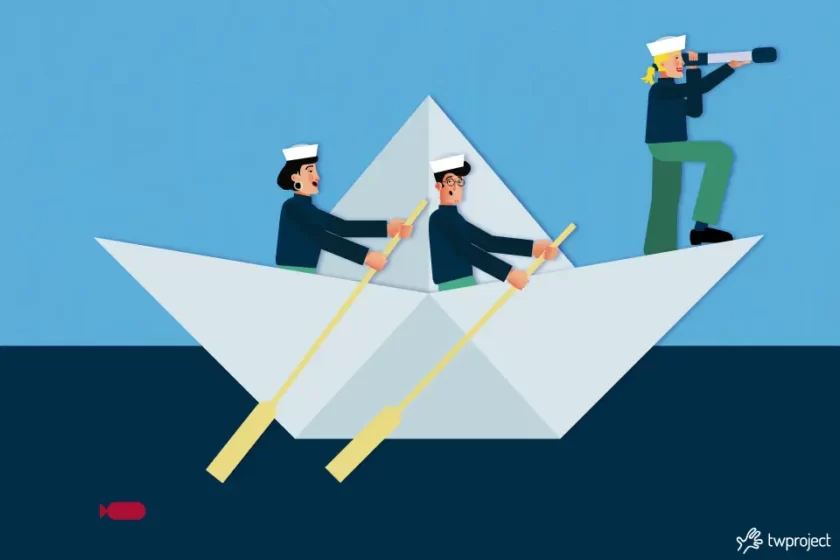
Liquid leadership is part of the modern work environment, marked by rapid change, remote work, and increasingly flexible organizational structures.
It is not just an evolution of traditional leadership, but a true paradigm shift that requires leaders to continually adapt to dynamic, distributed, and ever-changing teams.
In this article, we will take a look at what it means to adopt a fluid leadership approach, why it has become a key part of modern project management, and what skills a leader must develop to navigate constantly changing environments.
CONTENT
What is liquid leadership
Liquid leadership is an approach to team management based on flexibility, adaptability, and the ability to provide guidance in dynamic contexts. The term “liquid” refers to something that changes shape, adapts, and moves fluidly.
Unlike static hierarchical models, this type of leadership is based on several key principles:
- decentralization of decision-making power
- leveraging individual skills
- constant and transparent communication
- ability to deal with uncertainty
In an environment where teams are formed and disbanded quickly, where the required skills evolve, and projects change direction, a leader can no longer act as a controller but must become a facilitator.
Why liquid leadership is important today
Modern companies operate in complex ecosystems, often featuring:
- hybrid or fully remote work
- geographically distributed teams
- cross-functional collaborations
- short, iterative projects
In this context, workgroups are no longer stable bodies. Members come and go from projects, roles shift, and priorities change constantly. As a result, teams may include individuals with different backgrounds, diverse skill sets, and varying levels of involvement.
Liquid leadership arose to address this complexity, offering a model better suited to managing continuous change.
The key skills of a liquid leader
Adopting liquid leadership means developing a specific set of skills. Among the most important of these are:
- Adaptability: Leaders must be able to quickly adjust their approach according to the context. There is no universal effective leadership style, but rather the ability to adapt one’s behavior.
- Relational intelligence: Managing ever-changing teams requires empathy, active listening, and the ability to quickly grasp interpersonal dynamics.
- Effective communication: In dynamic environments, communication is key to avoiding misalignment. A fluid leader must ensure clarity, consistency, and transparency.
- Results-oriented: Even in dynamic environments, it is crucial to maintain focus on a common goal, avoiding disruptions and inefficiencies.
- Ability to delegate: Trust becomes a key element: the leader must empower their team, promoting self-reliance and accountability.
The challenges of managing dynamic teams
Managing constantly changing teams comes with its own set of challenges. Some of the main hurdles include:
- maintaining cohesion and a sense of belonging
- uickly aligning new members
- preventing information loss
- ensuring process continuity
Without the right tools and methodologies, the risk is that confusion will arise, projects will be delayed, and work will become less effective.
That’s why liquid leadership must be supported by a structured organization and digital tools that streamline management.
Tools in liquid leadership
In a dynamic environment, project management tools are key to bringing stability to processes while maintaining operational flexibility.
A platform like Twproject, for example, makes it possible to manage projects, tasks, and resources all in one place, providing a clear overview even when teams change frequently.
Through features such as:
- dynamic timelines
- task assignment
- real-time monitoring
- priority management
It is possible to maintain control without being inflexible. This allows leaders to focus on people and strategies, delegating operational management to the tools.
Moreover, the option to track progress and share information transparently minimizes the risk of misalignment, improving collaboration even among team members who have never worked together before.
How to implement liquid leadership
Adopting this approach requires not only operational changes but also a cultural shift. Here are some practical steps:
1. Build a flexible system: A flexible system doesn’t mean disorganization. Quite the opposite—it’s a set of clear yet adaptable processes designed to adjust to changes without losing effectiveness.
To achieve this, it’s essential to:
- define modular, easily customizable workflows
- avoid overly complex or bureaucratic procedures
- regularly update processes and priorities
- focus on goals, not isolated tasks
In a liquid leadership context, every project must be able to evolve without having to be redefined from the ground up each time. This means establishing a structure that supports change rather than hindering it.
A good approach is to employ hybrid methodologies, combining traditional planning elements with more agile practices. This way, you preserve the big picture while leaving room for continuous adaptation.
2. Promote information sharing: One of the main risks in changing teams is the loss of information. When people join or leave projects, know-how risks being lost, slowing down work and creating inefficiencies.
To avoid this, you need to create an environment where data and updates are accessible to everyone, avoiding information silos.
In this context, project management tools like Twproject make it possible to centralize all project information: tasks, documents, timelines and communications. This provides anyone joining the workflow with an immediate, clear understanding of the situation.
3. Invest in training: Liquid leadership requires self-reliant, versatile teams capable of adapting to different contexts. This is only possible through continuous investment in training.
A well-trained team is one that can adapt without losing productivity. Moreover, regular training fosters another key aspect: empowerment.
When people have the skills to handle situations, they become more self-reliant and less dependent on their leader.
4. Use the right tools: Without the right tools, liquid leadership is likely to remain just a theoretical construct. Technology is what allows you to manage complexity without losing control.
Project management tools must support:
- dynamic project planning
- flexible resource management
- ongoing activity monitoring
- collaboration across distribuited teams
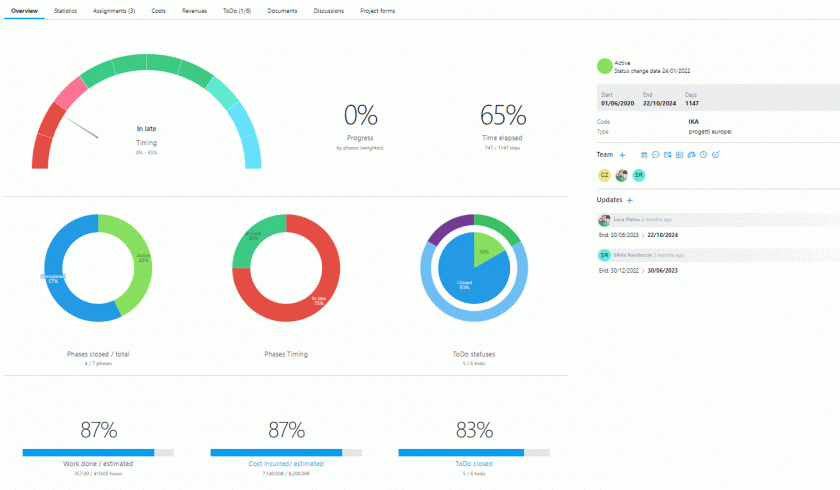
A platform like Twproject allows all these features to be integrated into a unique environment. For example, you can quickly change assignments, update priorities, and view the impact of changes on the entire project.
This is especially useful when teams change frequently: the system becomes the steady point of reference, while people move within it.
What’s more, having constantly updated data allows leaders to make faster, more informed decisions, reducing uncertainty.
5. Cultivate a culture of trust: Reducing direct control and encouraging individual accountability is one of the most delicate—yet crucial—steps in truly implementing liquid leadership.
In traditional settings, control is often perceived as a way to ensure quality and productivity.
Trust is the true driving force behind organizational fluidity. Promoting it means, above all, changing one’s perspective: not measuring work based on time or presence, but on results. This leads to a more mature and goal-oriented management style, where every team member is accountable for their own contribution.
Again, the right tools can make all the difference. By using platforms like Twproject, you can stay on top of work without needing invasive monitoring. Tracking progress, keeping track of tasks, and sharing information create an environment where leaders can trust their teams because they still have a clear picture of what’s happening.
This transforms control from direct supervision to data-driven, indirect oversight.
Liquid leadership and the future of work
Liquid leadership is not a fleeting trend, but a concrete response to structural changes in the work environment. With the rise of remote work, the gig economy, and global teams, this model will become increasingly relevant.
Companies that adopt it will be able to:
- respond more quickly to change
- attract and retain talent
- improve collaboration
- increase productivity
By contrast, those who remain bound to rigid models risk losing their competitive edge.
Managing dynamic teams requires a new approach to leadership. Liquid leadership takes a more human, flexible, and context-driven stance, capable of addressing the challenges of modern complexity.
It is not about abandoning structure, but making it adaptable. It does not mean giving up control, but redefining it through smarter tools and processes.
The future of team and project management depends on this balance between fluidity and organization, between autonomy and coordination. And the liquid leader will be the key figure to drive this transformation.