

How to structure a project is one of the most frequently asked questions for anyone involved in project management, regardless of industry or organization size. Effectively structuring a project involves more than simply organizing activities; it involves laying the groundwork for the work to proceed with clarity, accountability, and oversight.
A poorly structured project leads to ambiguity, wasted time, decision-making difficulties, and conflicts between those involved.
On the other hand, a well-structured project facilitates project management, makes progress easy to track, and increases the likelihood of achieving the final result.
CONTENT
- 5 mistakes to avoid when structuring a project
- 1. Starting without a clear and shared goal
- 2. Incorrectly determining stakeholders and responsibilities
- 3. Confusing activities with results
- 4. Planning without a realistic schedule
- 5. Overlooking the necessary monitoring and information
- Final checklist for your next project kick-off
In this article, we will discuss how to structure a project, highlighting five common mistakes to avoid, using a practical, operational approach.
5 mistakes to avoid when structuring a project
Understanding how a project is structured does not mean applying a one-size-fits-all formula; rather, it means building a solid foundation that allows the work to evolve without losing direction. Many projects fail or deliver results that fall short of expectations, not because of a lack of technical skills, but because of mistakes made in the early planning stages.
When the structure is weak, even operational decisions become challenging: priorities change constantly, responsibilities are unclear, and the final result risks straying from the project goals.
On the contrary, a sound structure helps the project manager and team members work with greater awareness, making it easier to coordinate and manage the project as a whole.
The following five mistakes are among the most common critical issues that arise when a project is kicked off without all necessary information or without considering what needs to be defined before starting. Recognizing them in advance allows you to avoid them and set up the project more effectively, reducing ambiguity, waste, and the need for subsequent corrective actions.
1. Starting without a clear and shared goal
The first mistake, often underestimated, is to start a project without first clarifying the desired outcome. Every project is conceived to meet a specific need, but this need must translate into a specific goal that everyone can understand.
One of the most common mistakes is to set overly generic or ambiguous objectives. “Improve a process,” “launch a new service,” or “optimize costs” are statements that can be interpreted in many different ways.
Structuring a project correctly means, first and foremost, defining the objectives clearly, measurably, and verifiably. Project goals must clearly state:
- what you aim to achieve;
- within what timeframe;
- what criteria will be used to determine whether your project has been successfully completed.
Without this clarity from the outset, even the best-planned project could be perceived as a failure because there are no objective evaluation parameters.
2. Incorrectly determining stakeholders and responsibilities
A project cannot exist on its own. It needs people, business operations, customers, suppliers, and decision-makers. Not thinking about this aspect can lead to some of the most critical mistakes during the planning phase.
Failing to properly identify stakeholders can lead to last-minute requests, resistance, or sudden changes in direction.
Likewise, not clarifying who does what within the team can cause confusion. Team members need to know:
- which tasks fall within their area of responsibility;
- which decisions they can make;
- who they should report to.
In this regard, the role of the project manager is pivotal: it must be clear who has overall responsibility for the project and who has operational decision-making authority. Without a clear structure of responsibility, the project struggles to proceed in a coordinated manner and must be renegotiated repeatedly.
3. Confusing activities with results
Another common mistake involves distinguishing between what is done and what is achieved. Many projects are structured as a simple list of tasks, with no explicit reference to the expected results.
A successful project, on the other hand, builds on results and develops tasks to achieve them. This approach helps maintain focus on the value generated, not just on the work done.
The expected results must be:
- observable;
- verifiable;
- related to the objectives set initially.
Only in this way can you judge whether the project is having the desired impact or whether you need to change direction. Once the Once the results are clear, the activities take on a precise meaning and become functional tools rather than ends in themselves.
4. Planning without a realistic schedule
Planning is one of the most prominent, but also one of the most misunderstood, pieces of a project’s structure. Plans are often either too detailed or, conversely, too vague.
To successfully develop a project, planning must be consistent with the level of complexity and uncertainty. A tool such as a Gantt chart is only useful if it represents a logical sequence of activities, with clear dependencies and realistic durations. In Twproject, planning takes into account people’s availability, making the plan more sustainable over time.
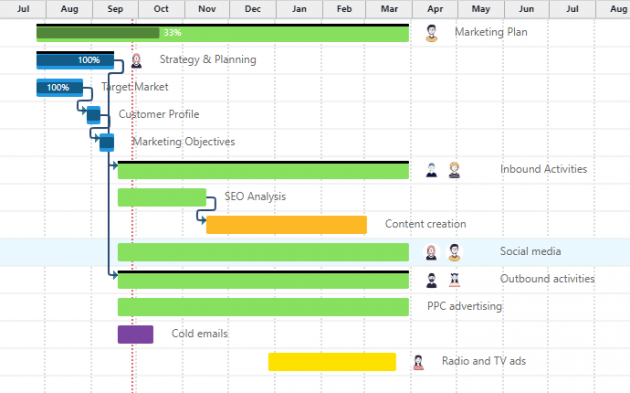
A common mistake is to plan without accounting for actual resources needed: time, skills, and operational constraints. A plan that ignores these aspects may be theoretically correct but impractical.
Moreover, planning can be progressive: not everything has to be specified down to the smallest detail from the get-go. Some parts of the project could be planned in more detail only when uncertainty is reduced. This approach makes the structure more flexible and sustainable.
5. Overlooking the necessary monitoring and information
The last mistake involves what happens after the project has been launched. Many projects are well thought out on paper, but lack an effective monitoring system.
Designing a project also means deciding how it will be monitored. Progress should not be based on gut feelings or assumptions, but on clear and shared information:
- activity progress;
- plan deviations;
- emerging problems and risks.
Without this data, the project manager cannot take timely action. Monitoring is not a paperwork chore, but a fundamental decision-making tool for effectively leading a project.
After setting objectives, responsibilities, results, and planning, monitoring helps keep expectations aligned and adapt the project to changes in the context.
Monitoring progress requires reliable and up-to-date data. Having all the necessary information in a single tool, such as Twproject, allows the project manager to take timely action before issues become critical.
Final checklist for your next project kick-off
To move from theory to practice, here’s a checklist to use before officially starting the work.
If you can tick all these boxes, your project structure is solid:
- SMART objectives: Can you explain the “why” of the project in two minutes? Is the outcome measurable?
- Stakeholders involved: Have you identified all decision-makers and everyone who will be impacted by the project?
- Responsibility matrix: Does every team member know exactly what they are responsible for and who has the final say?
- Communication channels: Is it clear to everyone where and how information is shared?
Realistic planning: Do the dates take into account holidays, other workloads, and dependencies between activities? - Risk analysis: Have you identified at least the three main risks and agreed on what to do if they occur?
- Success criteria: Has it been formally defined how the final result will be reviewed and “accepted”?
Understanding how a project is structured means going beyond simple activity planning. Structure is the set of choices that make the project understandable, manageable, and value-oriented.
By avoiding these five mistakes, you can build an effective project in which goals, people, timelines, and results are aligned. A good structure does not eliminate uncertainty, but it provides tools to manage it consciously.
Ultimately, a well-structured project must clearly state its purpose, have a solid framework, and be flexible in its execution. Only then does project management become a guided process rather than a constant scramble to deal with emergencies.


