
In project management, project outcomes are the real deal: the change generated by the project once everything’s done.
Time, cost, and deliverables are still major factors, but they’re not enough to tell if a project’s been a success. Without measurable outcomes, even a perfectly executed plan might not produce any real value.
Understanding what project outcomes are and how to measure them allows project managers to shift their focus from execution to the real usefulness of the work done.
Let’s explore why they are important.
CONTENT
- Definition of project outcome
- Why project outcomes are so important
- Project outcomes and objectives: the link to be clarified early on
- How to measure project outcomes
- 1. Translate outcomes into observable criteria
- 2. Link each outcome to one or more indicators
- 3. Define a baseline before starting
- 4. Separate operational monitoring from outcome measurement
- 5. Use project data to read outcomes
- 6. Integrating outcomes into continuous improvement
Definition of project outcome
Project outcomes are the actual changes generated by the project after the deliverables have been issued and used. They do not indicate what has been produced, but rather what effect it has had.
To better clarify the difference:
- an output is the direct result of activities (software, a report, a process);
- an outcome is the benefit or change achieved thanks to that output (reduction in time, improvement in quality, increase in efficiency, greater user satisfaction).
A project can be completed “successfully” from an operational point of view and yet fail from an outcome perspective if it does not achieve the expected impact.
Why project outcomes are so important
Project outcomes help connect your team’s work to the organization’s strategic goals. Without this connection, you risk only measuring internal efficiency and losing sight of overall effectiveness.
From a project manager’s perspective, working on outcomes means:
- evaluate success beyond the formal closure of the project;
- improve communication with stakeholders and sponsors;
- guide decisions during implementation, not just after the fact.
Basically, outcomes help answer a key question: Is this project really making a difference?
Project outcomes and objectives: the link to be clarified early on
Outcomes should not be determined once the project has started, but rather during the early planning stages. Every project is created to support one or more business goals, and outcomes are the operational translation of those goals.
A good approach is to formulate outcomes that are:
- observable;
- measurable over time;
- directly tied to an initial problem or opportunity.
This way, the project is evaluated not only on what it produces, but also on the changes that result from that outcome.
How to measure project outcomes
Measuring project outcomes means determining whether a project has generated the expected benefits, not just whether it was completed successfully. This step requires a methodical approach, because outcomes are often less immediate and more cross-cutting than outputs.
1. Translate outcomes into observable criteria
The first common mistake is to define outcomes that are too generic, such as “improving efficiency” or “optimizing teamwork.” To measure them, outcomes must be translated into observable effects.
For example:
- not “better coordination,” but reduction of overlapping activities;
- not “greater control,” but increased reliability of estimates;
- not “greater efficiency,” but a reduction in the average completion time.
A well-defined outcome helps to understand what needs to change in concrete terms compared to the initial situation.
2. Link each outcome to one or more indicators
Each project outcome should be associated with consistent indicators. There are no universal KPIs: metrics depend on the project type, organizational context, and strategic objectives.
The indicators can be:
- quantitative, such as time, volume, percentages, and costs avoided;
- qualitative, such as structured feedback, surveys, and before/after comparative assessments.
The important thing is that the indicator is:
- measurable over time;
- understandable to stakeholders;
- directly linked to the outcome, not to the activity.
3. Define a baseline before starting
Outcomes cannot be measured without an initial reference point. For this reason, the baseline is a key element in evaluating project outcomes.
The baseline describes the situation before the intervention:
- average processing times;
- number of errors or redo work;
- level of use of tools or procedures;
- degree of perceived satisfaction.
Without this preliminary data, there is a risk of relying solely on subjective assessments and impressions, thereby reducing the reliability of the analysis.
4. Separate operational monitoring from outcome measurement
An often-overlooked factor is that outcomes do not necessarily coincide with the project’s progress. A project may be formally completed while the outcomes have yet to become apparent.
For this reason, it is useful to differentiate between:
- monitoring of schedules, costs, and activities during execution;
- the measurement of outcomes at a later stage, often after the project has been completed.
In some cases, it is wise to schedule follow-up reviews weeks or months after closure to assess whether the benefits have been consolidated.
5. Use project data to read outcomes
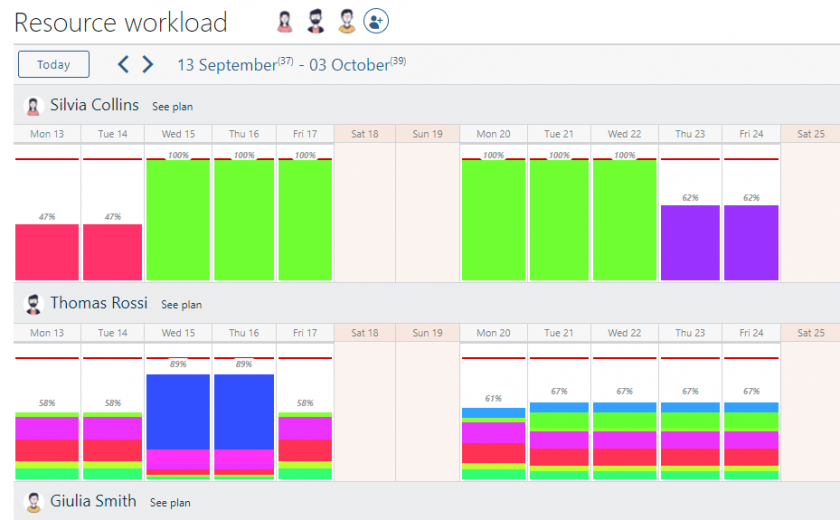
Project management tools such as Twproject indirectly help measure outcomes by providing reliable historical data: workloads, recurring delays, changes to plans, and resource usage.
This data is not an outcome in itself, but it becomes crucial for understanding whether:
- planning has become more stable;
- conflicts regarding resources have reduced;
- work predictability has improved over time.
In this regard, measuring outcomes is not an isolated activity, but rather the result of a conscious interpretation of project information.
6. Integrating outcomes into continuous improvement
Finally, and often overlooked, use the measured outcomes to improve future projects. Project outcomes should fuel:
- prioritization decisions;
- the definition of new project objectives;
- lessons learned at the organizational level.
When outcomes become part of the common language, project management ceases to be just operational control and becomes a tool for change management.
A practical example related to project management
Let’s consider a project to restructure internal planning. The output could be the adoption of a project management tool such as Twproject.
The outcome, however, is not the use of the tool itself, but the changes that result from its use: greater visibility into priorities, reduced conflicts over resources, and better coordination between teams.
In this regard, measuring outcomes means, for example, observing whether delays due to work overload decrease or whether the reliability of medium-term planning improves.
Project outcomes are the true indicator of an undertaking’s success. Defining them clearly and measuring them systematically helps to understand whether the project has produced useful change, not just whether it has been executed correctly.
For those who manage complex or multiple projects, working on outcomes reinforces the role of project management as a strategic lever rather than just an operational one.