

Effective planning for 2026 starts with a clear picture and turns it into concrete actions.
It’s not just about setting deadlines but about building a structure that enables teams to work smoothly and adapt to changes without losing control.
In an environment where complexity is mounting and resources are becoming increasingly distributed, sound project planning becomes the decisive factor in obtaining real value from the work performed.
Below are five practical steps to help project managers and teams organize activities, timelines, and objectives in a sustainable, measurable way.
CONTENT
Planning projects: 5 steps to follow
1. Define strategic objectives and priorities
The first step in any planning process is to gain a holistic understanding and clarify why the project exists and how it contributes to the company’s objectives. Without a shared direction, even the best plan is in danger of becoming nothing more than a purely theoretical effort.
At this stage, it is essential to establish the results you want to achieve and the efforts to prioritize for the year.
From a project management perspective, this means translating your strategy into measurable objectives, creating a direct link between your long-term vision and your operational activities.
Only then can your project be evaluated not only for meeting deadlines, but also for the value it generates.
2. Break down your project into manageable tasks
Once you have defined your goals, your next step is to get down to work. Complex endeavors can be broken down into smaller pieces, making it clear what needs to be done and in what order.
When considered as a whole, a complex project can seem unclear and difficult to manage. Conversely, when broken down into concrete elements, it becomes easier to understand whatneeds to be done, in which order, and who is responsible for what.
The most powerful technique is still the Work Breakdown Structure (WBS), and Twproject is designed to support it perfectly. It consists of breaking a project down hierarchically into deliverables, work packages, and, finally, individual tasks.
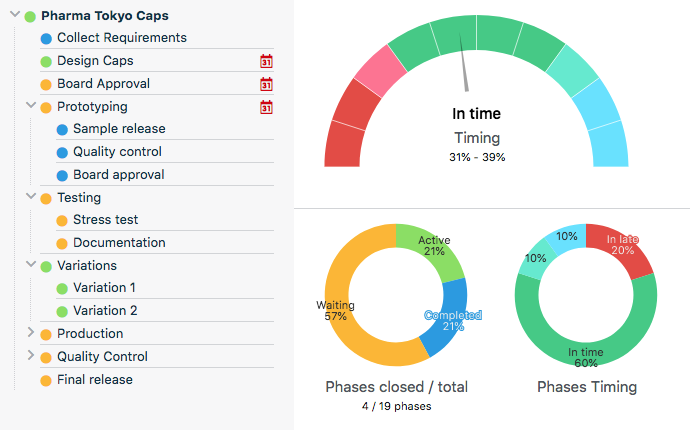
A project to “launch a new product” becomes a clear tree structure in Twproject with tasks such as “develop prototype,” “create marketing material,” and “train sales team.” Every effective plan stems from the ability to detail each task, avoiding ambiguity and overlap.
This breakdown helps you build a cohesive workflow where tasks can be assigned, monitored, and updated over time.
In Twproject, each task then becomes a dynamic element with its own timeline, files, and conversations. This makes project management more transparent and keeps the team focused on what matters.
3. Plan schedules, dependencies, and responsibilities
Time planning is a core aspect of project planning because it turns your list of activities into a practical roadmap.
With Twproject, this process can be managed by defining durations, start and end dates, and activity relationships. Dependencies must be expressed clearly, so that it is evident what can start immediately and what requires the completion of previous activities.
Using Gantt charts to visualize the plan makes it easy to understand and helps the project manager assess the impact of any changes.
Besides timing, it’s vital to assign responsibilities. In Twproject, each task can be associated with one or more responsible individuals, making it clear to each team member what their role is within the project. This approach reduces ambiguity, improves coordination, and strengthens individual accountability, all key elements of effective and sustainable project management.
4. Monitor progress and adjust your plan
A successful plan isn’t static; it evolves alongside the project. During the project phase, continuous monitoring is key to assessing whether the work is progressing as planned.
In Twproject, progress can be tracked in real time thanks to activity statuses, time tracking, and progress indicators (such as Earned Value). This allows you to quickly identify delays or critical issues before they have a significant impact.
When deviations arise, you can swiftly and carefully update your plan. Changes to deadlines, durations, or dependencies are applied immediately to the entire project, allowing you to assess their impact on timelines and workloads. With this flexible approach, you can adapt to changes without losing control, increasing the chances of successfully completing a project.
5. Evaluate results and capitalize on experience
The last step concerns something that is often overlooked: analyzing the final results.
In Twproject, you can compare what was planned with what was actually achieved to gauge schedules, costs, and workloads. This analysis helps you understand whether your original objectives were achieved and to what extent the project can be considered effective from an organizational and strategic perspective.
Capitalizing on experience involves leveraging the data collected to improve future projects. The historical information available in Twproject helps maintain continuity between projects, supporting more accurate estimates and more informed decisions.
This way, project management becomes a continuous learning process that can strengthen the quality of planning and overall performance over time.
Planning projects for 2026 means embracing a paradox: the need for structure to provide direction and the need for flexibility to adapt to change.
The five steps outlined above, powered by a platform such as Twproject, do not establish a strict framework but rather create a dynamic, shared roadmap.
This roadmap equips the whole team to navigate the uncharted waters of 2026 with agility, confidence, and the certainty that every effort is aligned with strategic goals.


